Cowper’s Cut 435: Centralisation, centralisation, centralisation

Every era of NHS leadership probably feels that it needs a slogan. Some have several: Simon Stevens had ‘thinking like a patient, acting like a taxpayer’, but also ‘the renewable energy of patients and carers’.
The current leadership era is an in-between, tail-end kind of moment: the legacy echoes of Team Milburn-Streeting mashed up with Interim Jim Mackey - an NHS leader reluctantly doing the national job on secondment (again). Current Health Secretary James Murray seems like a clean young man, but is unlikely to detain us much longer or more impactfully than Dr Therese ‘ABCD’ Coffey did.
In such uncertain times, we need an heroic figure to step forward and grasp the leadership moment.
So let us thank heavens for NHS England chair Dr Penny Dash, whose latest intervention this week certainly added to the gaiety of the health policy nation.
A lesser figure than Dr Dash’s might have been daunted by the departure of her erstwhile patron, Young Master Wesley ‘Over 200 Nominations’ Streeting, whose self-liberation from the health brief has enabled him to occupy his true destined role as The Man Who Will Not Be PM Andy Burnham’s Chancellor.
Not Dr Dash, though.
Putting the acre into care
 Caitlin Tilley
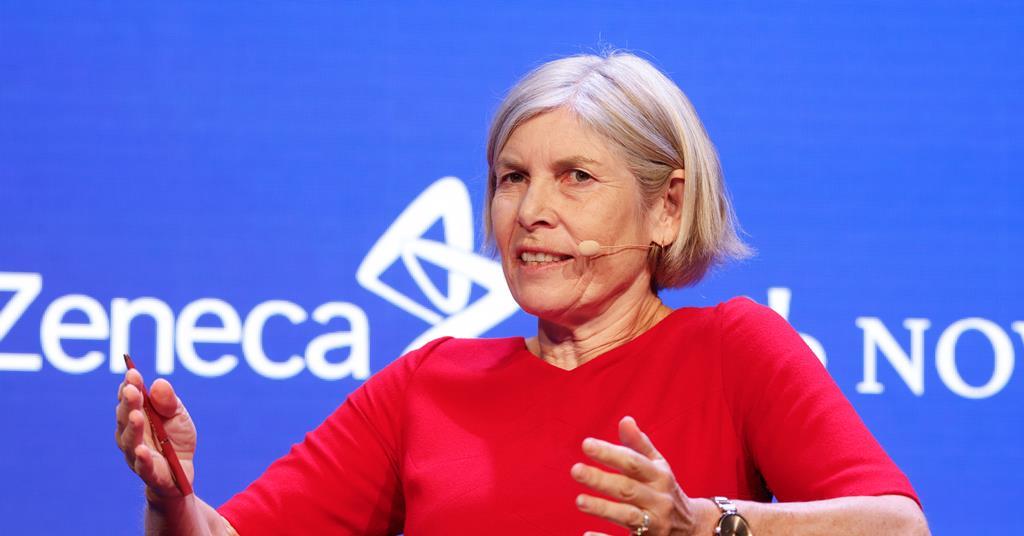
The famously flahoolagh real estate resourcing of primary care was Dr Dash’s theme this week. Health Service Journal reported her remarks to a conference that a “finger in the air” estimate suggested the English NHS has roughly double the primary care estate it needs.
Mmmmmmmm. To date, the over-abundance of superfluous space in primary care premises does not seem to have been a major feature in discussions about the major actual, real problems in primary care, in my experience. But maybe I wouldn’t know this primary care system: it goes to another school?
Dr Dash reportedly added that much existing GP estate was both in “poor condition” and “poorly utilised”, noting that GP premises were often not used fully for significant parts of the day.
There is a persuasive argument that if you can’t differentiate between billions and trillions when it comes to mental health real estate, as Dr Dash seems unable to, then you should avoid making any ‘finger in the air’ estimates about anything consequential until … oh, let’s stick a finger in the air and say ‘the end of time’.
It follows hard on her absurd AI utopianism covered in last week’s column, which segues neatly into today’s announcement in the Boris Johnson Fanzine that NHS England is to spend part of its £10 billion tech investment to put AI charmers on the front end of the NHS App. Dear God, this dim-witted BJF puff piece even features a James Murray-bylined bit.
Is Dr Dash doing this for a bet?
Or is she an undercover agent for Big Paper and The Typewriter-Fax Industrial Complex, aiming to discredit technology through Tony Blair Institute-type levels of billionaire-subsidised tech utopiansm and stealthily move us back to the days of slide rules, typewriters and physical carbon copies?
A farewell to arms’ length
 Caitlin Tilley
Dr Dash is playing a major part in current plans for the reunification of the roles of NHS chief executive and of Department For Health But Social Care permanent secretary, as reported in HSJ last month. Old lags will recall that this has been done once previously, when Sir Nigel Crisp took on both roles 2000-2006.
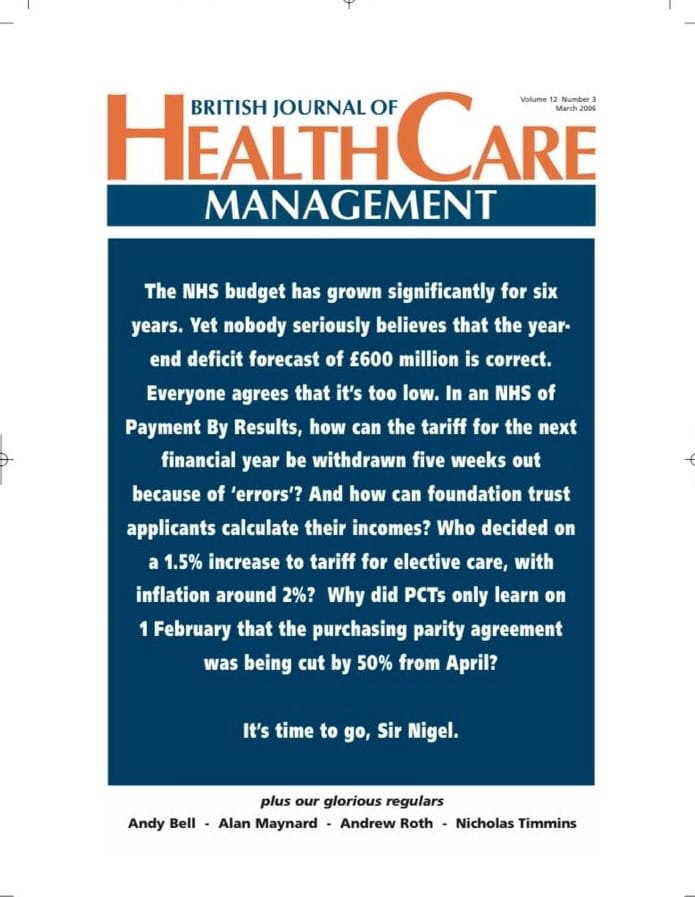
It is fair to say that that leadership era did not end triumphantly well, with what was then a second consecutive major year-end overspend in an era of 6% annual real-terms cash growth. The peerless Nick Timmins’ recent piece on this subject for the Kings Fund explores and explains some of the key historical context of the Crisp era. As Nick rightly observes, “the task of being permanent secretary of the department is a job that goes much wider than being chief executive of the NHS (which is itself a job big enough for anyone to fill).
“The permanent secretary, as things stand, is the official who is the accounting officer not just for the NHS but for the whole range of other ministerial responsibilities: for example, for social care policy and funding; for the Health Security Agency (think pandemics, Salisbury, and Porton Down); for the large elements of public health that are not part of the NHS; for key relations with the pharmaceutical and medical device companies via the Medicines and Healthcare Regulatory Agency (MHRA) and National Institute for Health and Care Excellence (NICE); for the bodies that regulate health professionals; and for broader relations – with the Cabinet Office and other Whitehall departments along with the international ones that include the World Health Organisation.
“In other words, the two jobs are too big for one person to do - and when combined, something is going to suffer”. As usual, Nick is Not Wrong.
It would be yet another remarkable step in a long line of remarkable steps towards greater centralisation of power in the NHS.
Why? To what benefit?
Centralisation, centralisation, centralisation
 Mr Andy Cowper

Readers may recall Dr Dash’s remarkable assertion from January of this year that “I don’t think that we’re centralising at all!”: a statement that she actually made out loud, in The Real World.
She might do well to listen to her chief executive Interim Jim Mackey, who told last month’s NHS ConfedExpo “you can look at the [NHS Modernisation] Bill and you can look at the change and think it’s a centralising thing, we’re building in too much control, [giving] ministers too much control.
“There has to be operational freedom in all this, otherwise we’ll grind to a halt.”
In a national health service that is inevitably locally delivered, tensions between the political and practical centrifugal and centripetal forces are both a feature and a bug.
The Covid19 pandemic saw the benefits of both approaches, with the early permissive approach to reconfiguring of estates and workforce teams empowering local front-line clinicians as rarely before (or since). Then there was (eventually) effective national co-ordination of the vaccination rollout, using the NHS Covid19 Datastore and Data Platform, developed with the help of Palantir’s ‘Foundry’ enterprise data integration and operations platform. (My usual COI declaration that in 2022 and 2023, I was paid for work on Palantir’s health advisory panel: see also below.)
There is no one definitive answer able to resolve the tensions between the valid arguments to centralise and those to decentralise. The dynamic tension between these two forces must be calibrated and managed carefully and wisely.
So we’ll definitely be fine, because there’s been such a reassuring surfeit of care and wisdom about the leadership of the place lately … oh.
 Alastair McLellan

HSJ editor Alastair McLellan's follow-up piece, which outlined options under discussion including the NHS chief executive reporting directly to the DHBSC permanent secretary, noted that “the post-abolition arrangements for how the centre will operate are being overseen by NHSE chair Penny Dash and DHSC lead non-executive director Alan Milburn, who merged the roles of NHS CEO and permanent secretary when health secretary.
“However, sources said that Mr Milburn was focused on other issues – such as his review of young people and work – and that Ms Jones increasingly represents the DHSC in discussions”.
Palantir data debacle, yet again
I don’t know whether there’s any truth in the Boris Johnson Fanzine’s speculation that Mascara Kid, former Health Secretary and soon-to-be Prime Minister Andy Burnham is minded to ensure that the break clause in Palantir’s contract for the Federated Data Platform will be used in 2027, when it arises.
On balance, it seems unlikely to me that the BJF’s senior political correspondent has fabulous insights into The Mascara Kid’s plans for power.
However, on balance it also seems that Palantir has not been doing itself any favours in terms of its likelihood of keeping the contract.
 Andrew Kersley

The Londoner, an excellent new media entrant, published this story interrogating NHS England claims that Palantir’s work cleared 183,000 patients from Chelsea and Westminster NHS Foundation Trust’s RTT waiting list. The article can find no reliable source to validate the claim, and notes that over the past three years of the FDP’s continued roll-out there, ChelWest’s RTT backlog has in fact been rising by 20,000.
The article observes that “across the 16 NHS Trusts analysed by NHS England, under data released last week to Foxglove and then reported by the Financial Times, a total of 217,846 outpatients had been cut from waiting lists. That means Chelsea and Westminster supposedly made up 84% of the improvements being attributed to the FDP”. This statistic seems heroic, to the point of extreme improbability.
This data debacle is the opposite of a surprise. Back in April 2026 (and indeed I think earlier, but can’t immediately find it), I wrote about the unverifiability of Palantir’s NHS data claims: specifically about “the evidence basis of the 2022 PR claim to the FT that a “recent pilot of Palantir’s Foundry system at the Chelsea and Westminster Hospital Trust helped reduce the inpatient waiting list by 28 per cent — the equivalent of tens of thousands of patients — for all non-emergency surgeries, including for cancer treatments” (which) was never published …
“When I was a paid member of the Palantir health advisory panel, I repeatedly asked for this information to be shown to the panel and released into the public domain. Despite some reassuring-sounding waffle, it never was.”
If you arrive as a company with a reputational nefariousness issue, then complicity in making high-handed and unsubstantiated claims based on unpublished data is going to be a bad move. This is the kind of shit that pharmaceutical companies routinely pulled in the 1970s and 1980s.
It was unsurprising that DHBSC officials this week confirmed to the FT that their permanent secretary Sam Jones has recused herself from any role in decisions about the 2027 break clause of the FDP contract with Palantir.
Recommended and required reading
HSJ reports on three new ‘top team’ appointments to NHS England, which has cued informal, well-informed speculation that it indicates that NHSE Chief Operating Officer and National Priority Programme Director for Urgent and Emergency Care Sarah-Jane Marsh is being prepared to be the next Care Quality Commission chief executive. If this guesswork is correct, let’s hope that she has thought the implications of that particular Black Spot through fully.
The Boris Johnson Fanzine reports on a new peak in the number of medics making Certificate Of Good Standing applications to the GMC: CGS requests usually being a sign of firm intent to start practising medicine in another country. 12,255 doctors applied to their regulator for CGS paperwork in 2025: “up by around 20 per cent on 2024, and more than double the number of such applications made in both 2020 and 2021”. Erm, hang on, BJF: wasn’t something happening in 2020 and 2021 that makes them a bit of an outlier?
HSJ comment piece by Patricia Hewitt on information sharing.