Cowper’s Cut 434: As the PLP’s Mascoronation of Andy Burnham approaches, a new Ockenden Report drops - but the Penny hasn’t dropped about who actually uses the NHS

Time is even more of an abstract concept during a heatwave, isn’t it?
The Second Coming of Andy Burnham
As we are conveyed inexorably towards the arrival of The Mascara Kid Andy Burnham as Labour leader and Prime Minister, it is clear that the Parliamentary Labour Party is going to present the nation with a Mascoronation, and not a competition.
This will matter, politically: whatever Manchesterism means (this week) will not have been challenged or debated by people with competing approaches.
That will be handy for Team Mascara Kid: it will maximise their room for manoeuvre once they take charge. They will be travelling as ideologically light as possible.
However, the nation has just had a go on a Prime Minister and Labour leader in Sir Keir Starmer who didn’t seem to actually have any political beliefs or philosophy, and it would be fair to describe this experience as having been a less than completely happy one for both nation and Sir Keir.
The clearest picture of what Manchesterism has meant in practice is in this excellent long read by Jennifer Williams for the Financial Times. It describes a man with a yogic level of political flexibility. Williams writes how in February 2015, Burnham told her that he “was so incensed at the devolution plan that my shorthand struggled to keep up with his concerns — it would lead to complex reorganisation and punch holes in the NHS “like Swiss cheese”, he told me. If Labour were to win that summer’s general election, he said, “I wouldn’t be offering this deal”.
“ … less than a year later the same issue came up again. This time, we were in the upstairs room of a boutique city centre hotel, where he was announcing his ambition to become Greater Manchester’s first mayor. Slightly jarringly, that pitch included big plans for the devolved health system he had been so upset about before. Social care, he was now telling me, would be renationalised under his 10-year leadership vision.”
One can be simultaneously inclined to applaud The Mascara Kid’s sheer chutzpah and underwhelmed by the Damascene nature of his apparent conversion.
Unfortunately, although I also recommend Sam Freedman’s piece on Burnham’s likely approach to public policy, we are about to see the arrival of a new Prime Minister and team who have yet to meaningfully articulate what they want to do in public sector reform, let alone how they intend to do it.
The most likely reason why they have not yet articulated this is that they do not yet know.
This risks leaving them wide open to bullshit merchants, salespeople and policy entrepreneurs: a range of outcomes which may well prove sub-optimal.
The Second Coming of The Mascara Kid may not be what the fans expect.
And speaking of former Health Secretaries …
The Man Who Will Not Be Andy Burnham’s Chancellor, Young Master Wesley ‘200 MP Nominations’ Streeting has spent the week trying to brief his way into a Burnham Cabinet job. Plus ca chancer, plus ca change, as they say in the trade, though I’m not sure which trade.
Longstanding fellow fans of Young Master Wesley may enjoy this score-settling piece in the Boris Johnson Fanzine by his former speechwriter: the by-no-means-embittered Arthur Reynolds. It confirms what ‘Cut’ readers have known for ages: that Alan Milburn was the organ-grinder to Streeting’s performing monkey.
Specifically, it confirms that the 10-Year Plan was hijacked by Alan Milburn, who, using Mr Streeting as a convenient amanuensis, was largely in charge of the Department For Health But Social Care.
It’ll be interesting to see if Milly stays on as DHBSC lead non-executive director.
The latest Ockenden Report sees no lessons learned from past maternity scandals
Donna Ockenden’s latest report on maternity services at Nottingham University Hospitals NHS FT is an extremely depressing read. But then, so were the Kirkup Reviews of Morecambe Bay and East Kent, and the previous Ockenden Review of Shrewsbury and Telford. The national review of 12 other NHS trusts’ maternity services led by Baroness Valerie Amos will be, too.
‘Lessons will be learned’, we are always told, when another such scandal breaks in the media. We are, however, never told when or how they will be learned. Or by whom.
The expressed preference of NHS management teams in whose trust there has been a care quality scandal has been to apologise for past failings, and promise that ‘lessons will be learned’. The revealed preference of these teams is often to do nothing of any practical use about dangerous services.
Even though we have known for decades that the services most likely to have quality scandals are in the mental health, learning disability, maternity and neonatal and residential social care sectors, what we have that just about passes for health and care quality regulation remains appalling at finding these problems.
It is one of many ways in which health and care quality regulation, like medical professional self-regulation, is quite dangerously broken. I’ve been on about this for a while now.
As Mannion and colleagues wrote in 2019, “while organisational and systemic factors are undoubtedly important, there is a need to keep in sight the role of individuals, for two key reasons. First, there is growing evidence that a small number of doctors may be disproportionately responsible for large numbers of complaints and concerns. Second, there is a risk that the role of individual professionals in drawing attention to wrongdoing is being neglected”.
I’m nodding my head to this so vigorously as to be in danger of whiplash.
And it seems clear from reading the various maternity reviews that there is something profoundly rotten in the culture of midwifery as it is being practiced in a significant number of NHS trusts.
So is it about a low number of midwives per pregnant women? Is the problem work-stress-driven?
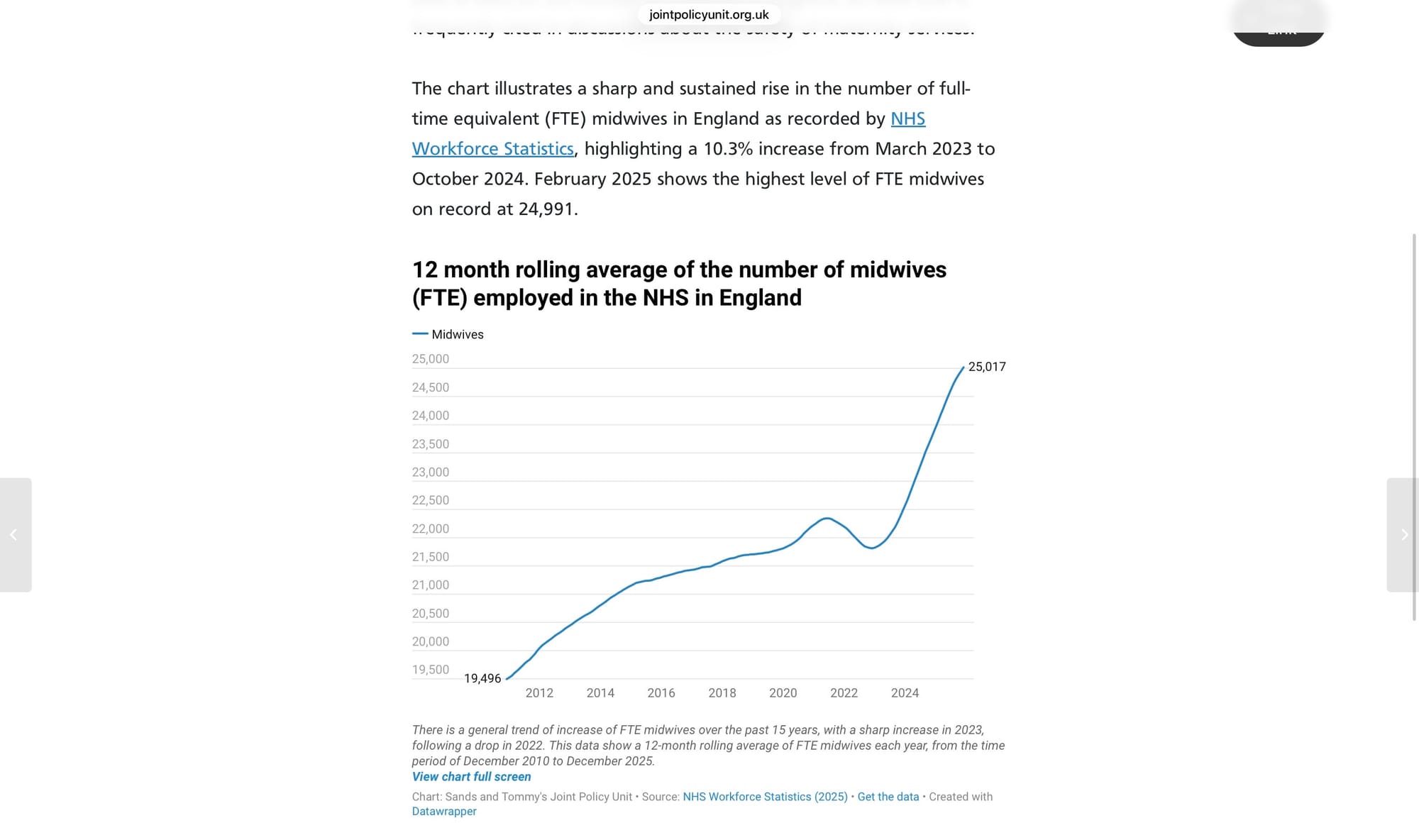
It does not seem to be. The ONS data reveals that there were 585,396 live births in England and Wales in 2025: in 2010, the number was 723,913 (of which 652,377 were in NHS hospitals).
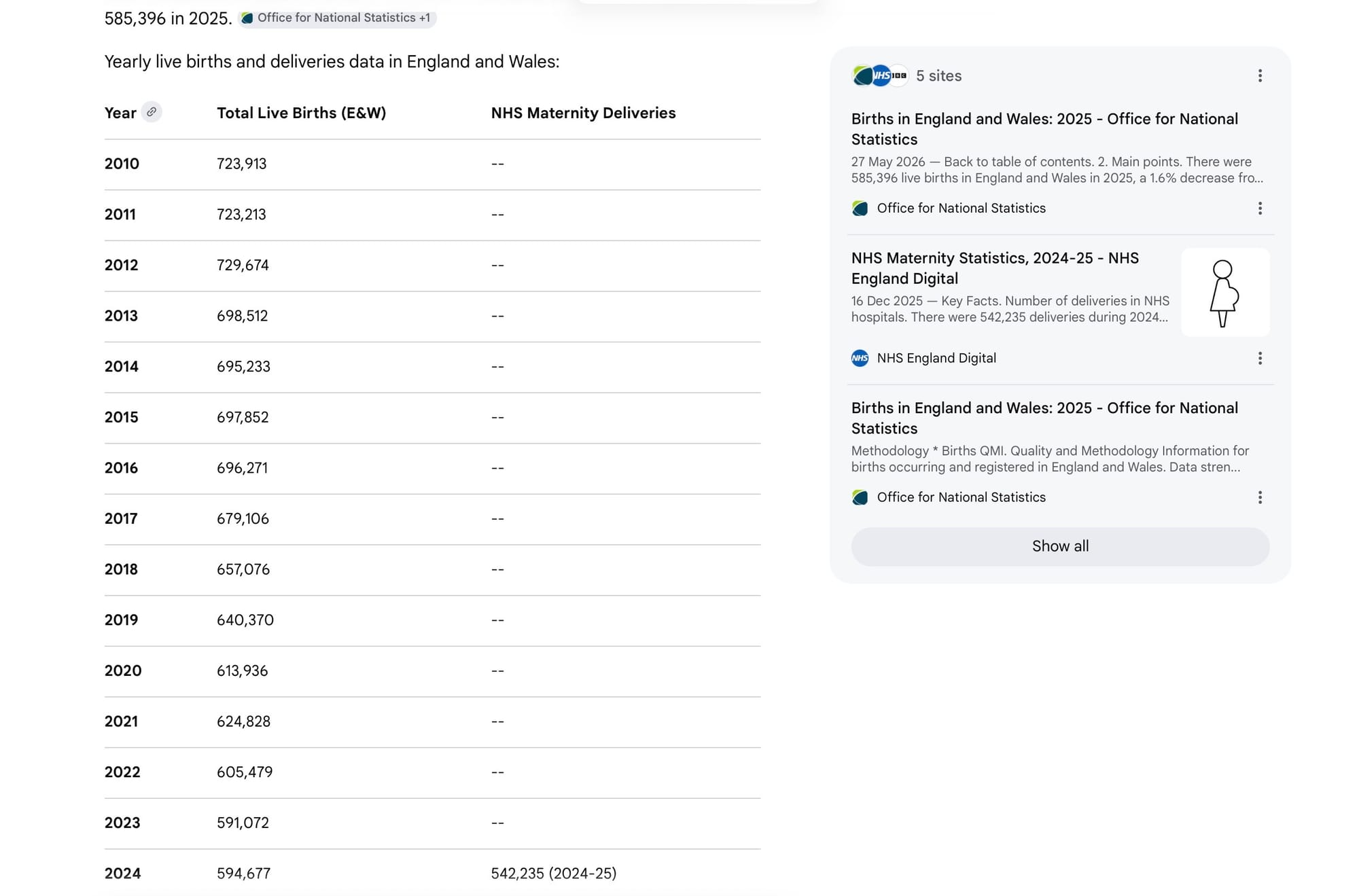
So even if the 2025 live births are to older, fatter and more medically complex women, demand has been steadily falling while midwife numbers has been steadily rising.
The Penny is yet to drop about who uses NHS services
Depressingly, it’s difficult to be sure that there hasn’t been a stupider intervention this week than NHS England chair Dr Penny Dash’s comments to HLTH Europe that “If I look to the future, some of the things that are being developed and coming downstream, like fully automating a care pathway, are phenomenal.
“That means I would put into my phone that I have got these three symptoms, software would ask me questions, would take a photo and video me lifting my leg or lifting my arm, and the first time you would see a human being would be on an operating table.
“With AI, we could do that for pretty much all health conditions. We don’t necessarily need — which will frighten a lot of people — doctors and nurses. You will not want dirty, clumsy hands inside your body. It will all be robotics and non-interventional approaches.”
Oh, for fuck’s sake. This is almost as insightful and spot-on as the articles I have been reading every year for the past 25 years, which have been vowing that driverless cars will be arriving next year. Hypebeasting bullshit about tech is nothing new. This is worth reading about driverless cars’ safety records, BTW.
Is Dr Dash looking for a private sector health tech berth, once NHSE is abolished?
One must have a heart of stone not to laugh at this spectacular clue-deficit, even by the subterranean standards of the person who claimed out loud, in The Real World, that “I don’t think we are centralising at all!”
I am starting to wonder if Dr Dash has ever been into an NHS hospital. As ‘Cut’ readers well know, they are full of almost unbelievably old and frail people. This argument is so ignorant of who actually consumes most healthcare.
It’s rather interesting that no journalist ever asks the obvious question: if Artificial Intelligence (surely to be outpaced by organic stupidity) is so capable that it will eventually investigate, diagnose and make life-critical decisions about the management and rescue of an absurdly complex human biological system, then how come nobody’s talking about a much-nearer-term future in which it can also save loads of cash by clearing out and replacing the legions of desk jockeys at NHS central command?
Now, of course it’s absurd to suggest that AI might in any way be capable of the latter.
But then you’ve gotta ask, what are the chances that Penny’s NHS / ‘Blade Runner 2049’ mash-up comes to pass?
What Dr Dash futurologises may eventually work fine for the episodically or trivially ill. That is not most NHS users.
It reminds me of Paul Corrigan’s obsession with being able to register with a GP where he worked. This was something he very much wanted, but it was also a massive non-issue for most significant consumers of GP services.
This is Roy Lilley-level futurology: Hancockism without Hancock.
And that is a grim thought indeed.
Recommended and required reading
Last Not-Unserious English Health But Social Care Secretary Jeremy Hunt sets out his case for Andy Burnham to set aside the mascara and to genuinely cancel national NHS targets.
It’s Federated Data Platform contract winners Palantir again (COI dec: the company on whose Health Advisory Panel I was paid to work in 2022 and 2023), again in the FT: the Real Pink Paper reports on NHS England’s claims that its FDP has contributed to 110,000 additional operations being carried out and to a 15 per cent reduction in discharge delays (figures widely cited as evidence of the platform’s success). “But in a recently updated NHSE page outlining the methodology behind the figures, the health service stated it could not “draw conclusions about cause and effect as other variables have not been controlled for”. The statement, which is repeated seven times, did not appear on an archived version of the website from May and does not appear on the main uptake and benefits page”. Ooooops.
Alan’s back! With Kylian Mbappé! And spectacular claims about AI health tech, reported in the FT. (No, it’s not that Alan: not the proper one.)
On-trend but very poorly-reasoned and referenced FT article buys the idea that young people can (and do in meaningful numbers) opt out of the NHS. Only the ones with very rich parents and who aren’t consequentially ill, in my experience.
IPPR Health And Care Conference apparently happened this week: bit surprised not to have had an invite, tbh.
The Thunderer reports that ‘Doctors banned in EU use Brexit loophole to practise in UK’ and that ‘NHS hires thousands more British junior doctors by giving them priority’.