Cowper’s Cut 451: The Madame Tussaudsification of national NHS leadership
Prime Minister Andy Burnham’s passionately-delivered speech to the Labour Party conference was striking because of its content. As in, there was some. He made an actual argument, and didn’t waste time bashing the other political parties. He also faced fiscal reality and its evil twin political risk, making few short-term promises.
All the major changes he pitched, such as the creation of a National Care Service and the changes to the state pension triple-lock, will not happen until the other side of a General Election that today looks remarkably likely to be in 2029. Indeed, given the macroeconomic picture, the National Care Service may not happen until well on the far side of that date.
This is grown-up politics, and that is rare - and so I am formally retiring his nickname of ‘The Mascara Kid’. He has outgrown it.
Burnham’s vision in this speech was very much domestic: this will take some keeping-to, given the UK’s open, financialised economy in a globalised world (albeit one trending to retreat from globalisation’s logic and rules).
The speech was not without room for improvement: in the ‘housing’ section, Mr Burnham asserted, “We don’t let people sell food which damages health. So why allow it with homes?” This is balls. We massively allow people to sell food which damages health: deep-fried chicken shops seem to be taking over high streets everywhere, and particularly near schools. Ultra-processed foods proliferate, undifferentiated in tax terms.
We heard about the roots of Burnham’s “long-held ambitions to reform social care. When I was a new MP in the early 2000s, I despaired at what I saw when my gran Kitty went through the system. I winced at the pain it caused my mum. My gran’s engagement ring ripped from her finger and stolen in a care home. Care not worthy of the name. And the modest savings she had built up through her life, starting from the house where I was born? All taken to pay for it.
“I vowed then to fight for something better for my parents’ generation. And here we are 25 years later. If anything, it’s worse today than it was then. What an indictment of my generation of politicians, myself included. Too cowardly to fix something as basic as the care we give to each other. Is it any wonder people are giving up on politics?”
The section on the care and NHS workforce is instructive: he told social care workers “you are not invisible to me. I see you. I thank you. And I am sorry that my profession has let down yours for so long. I promise you: I won’t leave this job without doing everything I can to change things for you.
“And I say the same to our wonderful NHS staff. We have let you down too. Left you under intolerable pressure. At risk of burn-out. Dealing with 999 calls from a failing care system. Corridor care your daily reality.
“If we carry on like this, Conference, broken social care will break the NHS too. And we can’t let that happen, we must never let that happen, this party that founded the National Health Service.
“There is only one real answer. A person-centred, high-quality care service that starts in the home. A system in the best traditions of this party, where everyone contributes and everyone is covered. Free at the point of use and no care charges paid out of your basic state pension …
“This is the National Care Service we will build … A landmark policy as significant as the creation of the NHS itself. And utterly essential to securing its future. NHS savings from fewer ambulance call-outs, A&E admissions and vulnerable people being stuck unnecessarily in hospital.
“We will start laying the ground now for the National Care Service and introduce it in the next Parliament. Louise Casey’s review will advise us on exactly how and Yvette and I will seek to build the maximum national consensus around her recommendations. It will be fully funded, and not through borrowing.”
Caveat time
Plenty there. In a BBC News interview after the speech, a brief aside in an interview with Labour’s deputy leader Lucy Powell let a cat out of a bag by revealing that the plans will not cover accommodation costs in nursing or residential care settings, so it looks very much like personal care only will be state-funded.
Indeed Mr Burnham told the BBC the following day that “you will have to pay for your bed and board”.
Prominent social care review author Sir Andrew Dilnot told the Financial Times, “the Scottish system does not protect homes and savings” because care home residents are still left paying tens of thousands of pounds a year.
“The risk to people’s homes and savings is largely for those who enter residential or nursing care. A genuinely free and universal care system would have a very substantial cost. A system that made universal payments but at a level that would not cover costs in residential care would be cheaper, but would fail to cover catastrophic costs and to protect houses and savings.”
As I wrote in last week’s column, Mr Burnham deployed the trope of threatening that without this National Care Service reform, the NHS will be broken: a suggestion that fails to consider the possibility that in several important aspects, the NHS already is.
As to the promise of “NHS savings from fewer ambulance call-outs, A&E admissions and vulnerable people being stuck unnecessarily in hospital”, well … maybe. But recurrent and cashable savings come when you can have fewer facilities or staff. Is this realistic?
In the ‘young people’ section of his speech, Mr Burnham pledged that the young will face “no long waits anymore for mental health support growing up”, which sounds a) lovely, and b) very expensive.
It might also be unhelpfully incurious about what is driving the huge rise in demand for mental health services for young people. The Centre For Mental Health’s ‘Future Minds’ publication is well worth a look.
All the staff need is love
The key takeaway is that people who have been working hard to make it abundantly clear that NHS staff are having to work in unacceptable and dangerous conditions have successfully got their message through to the PM’s world.
This is good news.
Less clear is whether this important realisation is accompanied by an equally important understanding that many problems in NHS operational performance are driven by shortcomings in the design and management of the system.
These are design and plumbing and wiring problems, and they matter greatly, as I discuss below.
System? What system?
There is a broader point. The remarks that we heard at the conference, from PM Burnham and from new Health But Social Care Secretary Yvette Cooper (whose strongly feminist speech, tellingly, is not on the Labour Party website but on their fanzine Labour List’s), indicate a focus of attention on both the staff and patients of the NHS.
That is a valuable focus, but an incomplete one.
As committed system geeks, ‘Cut’ readers will have spotted that there has been no discourse on or indeed mention of the English NHS system from its new political leadership, which will soon be in total and unchallenged control of that system.
This might not be a big problem if the system were working well.
But the system is not working well. And many of its dysfunctions in quality and safety, such as high rates of harm in A&E and maternity services, relate to the national leadership having been in ‘bystander’ mode for some years now.
It is not new news that national attempts to improve provider A&E systems are fundamentally ill-conceived; nor that some maternity services have been consistently dangerous for years. Bill Kirkup and Donna Ockenden no doubt wish that this were otherwise, as do many parents of harmed or dead children.
Look at East Kent, where this week, Health Service Journal reported that Des Holden, former medical director and acting CEO since late last year told its board on Thursday, “we have kept maternity under review at the board and we seem to have got quite a lot of assurance … so it is quite shocking to get this report and find we have let so many people down.” Congratulations to Dr Holden for his rare and welcome honesty, but this is a trust with well-known quality and safety problems in maternity going back a very long time.
The job of any national leadership worthy of the name is to a) quickly notice these things, b) do something effective to improve them, and c) check that this improvement sticks.
It is impossible to claim that the national leadership of the NHS in England has delivered on this for at least the last five years: clearly longer, in the specific case of maternity. Instead, the guilty provider playbook has been deny, delay and try to legal it away. If you don’t agree with this, then you need to go and read all of the Kirkup, Ockenden and Amos reviews and then come back with an argument.
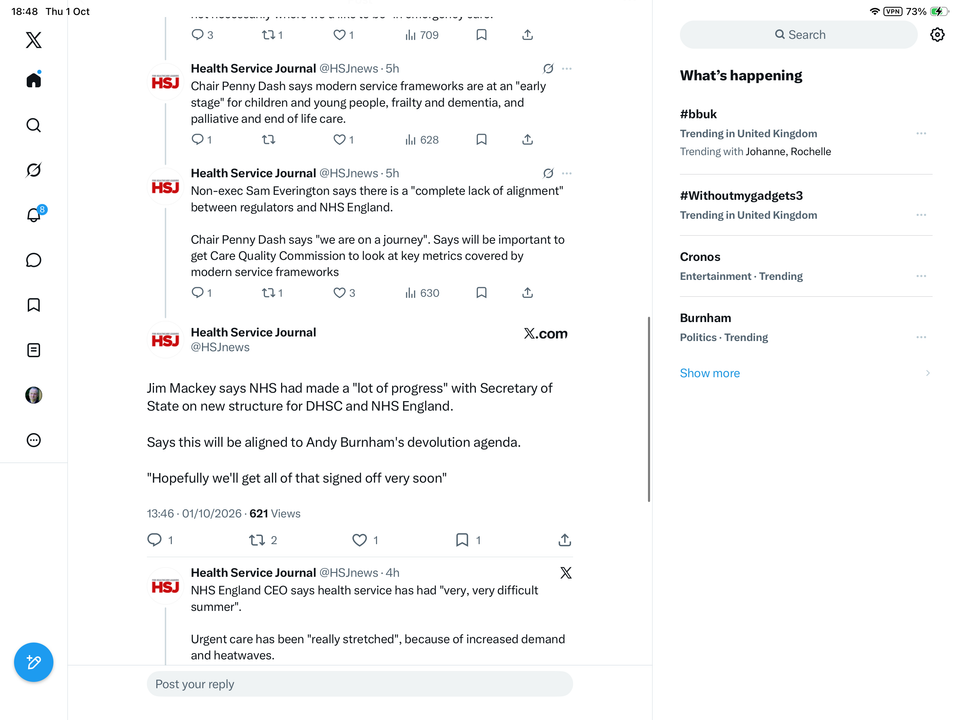
And of course, quality regulation in the English NHS is profoundly broken. As NHSE NED, the eminently sensible GP Sir Sam Everington said at the NHSE Bored meeting this week, there is a “complete lack of alignment” between NHS regulators and NHS England. (NHSE chair Penny Dash’s use-free reply to this, “We’re on a journey”.)
The quality of management is not strained?
For a while now, I’ve thought that a conversation about the median quality of management in the NHS is required.
It seems to be starting, albeit in a crude way. The Thirlwall Public Inquiry’s findings put their faith in regulating managers: unfortunately, this feels more like treating symptoms than causes. Although that said, I strongly recommend Ken Jarrold’s call for the TPI findings to emphasise a values-driven approach to renewing NHS management.
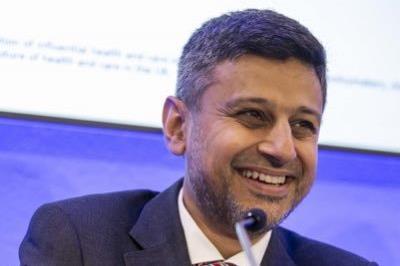
This week, Wes Streeting’s former PPS bag carrier turned former junior health minister Dr Zubir Ahmed MP told a Labour Party Conference fringe meeting that “I would say there is a quality and accountability issue with NHS management … half of the managers I encounter[ed] in the last 20 years, if I had a chance, I would sack them in a heartbeat because they are not good enough”, as HSJ's Zoe Tidman reported.
Dr Ahmed also suggested that the NHS needed to stop moving “the worst” clinicians and nurses into leadership roles.
 Zoe Tidman
It is possible to recognise the displacement activity that Dr Ahmed is talking about, while also recognising that the revolving door of purported rehabilitation operated by local and national system leaders is by no means confined to poor clinicians.
And ‘half of them’ feels much more like a convenient soundbite of a ‘nice round number’ than any meaningful attempt to quantify the problem of substandard managers.
Beyond bystanderism
I described the phenomenon of ‘bystanderism’ in NHS regional and national leadership two weeks ago. I wondered if it might have gone a bit far, but the feedback from quite a few subscribers told me that it went not nearly far enough.
I reflected on that. I think the people who offered that feedback were right.
The national leadership that we have ‘enjoyed’ for the past several years has been remarkably incompetent. One good example: it was clearly ridiculous that the national leadership had to offer ‘advice and guidance’ about how to deal with NHS staff who, by snooping on patient records in high-profile cases without any legitimate reason, committed what anybody in their right mind would instantly recognise as gross misconduct sufficiently severe to merit immediate dismissal. Obviously, a process needs to be followed, but in such cases, it is not complex.
While it was still happening, I dissected the 2021-25 ‘everything, everywhere all at once’ era of Amanda Pritchard’s less-than-effective tenure in charge of NHS England - perhaps to the point of wearying readers. I regret it, if that was the by-product: it wasn’t intentional.
But nobody else was articulating it, and it had to be said.
Matters have not improved substantially since then.
Unfortunately, Dr Penny Dash’s public policy comments as NHS England chair have more or less reached the ‘random ideas generator’ stage. One almost wonders if Dr Dash is about to pitch ‘Monkey Tennis’ as the next big digital solution to save the English NHS.
The bromance between Department For Health But Social Care lead NED Alan ‘Shut The Door On Your Way Out’ Milburn and NHSE pro tem leader Sir James Mackey - Interim Jim - may have made both men slightly happier than they’d otherwise have been. Which is nice. It certainly increased NHS national leadership discussions on association football in the north-east region, in a manner to warm the heart of any productivity geeks who specialise in that particular niche.
One must have a heart of stone not to laugh at Interim Jim’s statement to the Bored that the NHS has made “a lot of progress” with the new SOS on the new structures for DHBSC and NHSE, which will be aligned to Andy Burnham’s devolution agenda.
Oh no they won’t. As these columns have been pointing out for many months now, the Health Bill going through Parliament massively centralises English NHS power, and the new government’s rhetorical plans do the opposite. At some point, this will be noticed.
The circular firing squad of NHS England’s leadership cadre was depressingly obvious at their latest Bored meeting this week. Boy, that was depressing.
A set of ‘God, aren’t we shit at this?’ arias is, frankly, the legacy that this version of NHS England deserves. They are bringing in staff without due process. Their tech stuff is a mess (etonnes-moi, Diaghilev!)
 Caitlin Tilley

I was slightly stunned to see the promise from an organisation that will no longer exist in eight months’ time that GP practices will receive “tailored letters” detailing their performance and stressing the “potential for contractual action” lest they might fail to meet required standards.
Heroically, NHSE is “also preparing to improve operational grip through review at regional performance and assurance group meetings”.
I don’t want to be more disagreeable than is strictly necessary, but what the living fuck have these people been doing all these recent years?
And, why do they think that this tail-end performance virtue-signalling is going to make a tuppeny fuck’s worth of difference with this pointless show of non-strength?
Only Madame Tussauds Syndrome can save us now
Bystanderism is not quite strong enough.
Most of the current and recent national NHS leadership has Madame Tussauds Syndrome: they have been completely immobile and inert; but dressed up as if they were leaders; pretending to act like leaders; and (if you really squint hard) you could almost claim that they look very slightly like leaders.
But they are waxworks.
Simulacra.
It gives me hives to quote postmodern theorist Jean Baudrillard, but his piece on this feels very prescient.
Recommended and required reading
Sixteen English councils spent more than 80% of their core funding on adult and children’s social care last year, Guardian analysis shows.
This new documentary film about convicted medical fraudster Theranos’ Elizabeth Holmes seems pretty wild.
Another good ‘Mythbuster’ column from Steve Black in HSJ, pointing out (slightly less politely than the recent NAO report) that national A&E strategy is completely wrong and has failed.
Times interview with Professor Sarah Blagden, whose team are relics to develop a vaccine against small cell lung cancer.
The definitively-briefed Financial Times campaign to out the problems with Palantir’s FDP continues, with a report that Team Burnham are looking for UK-owned alternatives. Which do exist.
Guardian piece by Devi Sridhar on why Britons are not ageing healthily, and how to learn from countries that have made healthy ageing a priority.
Polypharmacy? We hardly knew her: Shaun reports on a new simple blood test that could tell GPs which medicines are the safest and most effective for elderly patients taking multiple prescriptions.