Cowper’s Cut 442: Is the English NHS poorly managed?

I’ve been wondering for some time now about the median level of quality of management in the English NHS.
Having been writing about the policy, politics and management of the NHS since 2000, my view until about 2015 or 2016 would have been that despite some radically curious bits of national policymaking (most notably the Lansley reforms), NHS management was, broadly, pretty capable.
The national and intermediate tiers were roughly cohesive, and despite the persistence of ‘heart-sink’ provider trusts (often rural/coastal) with big, consistent and apparently intrinsic quality problems, there seemed to be an impressive cadre of leaders in many places.
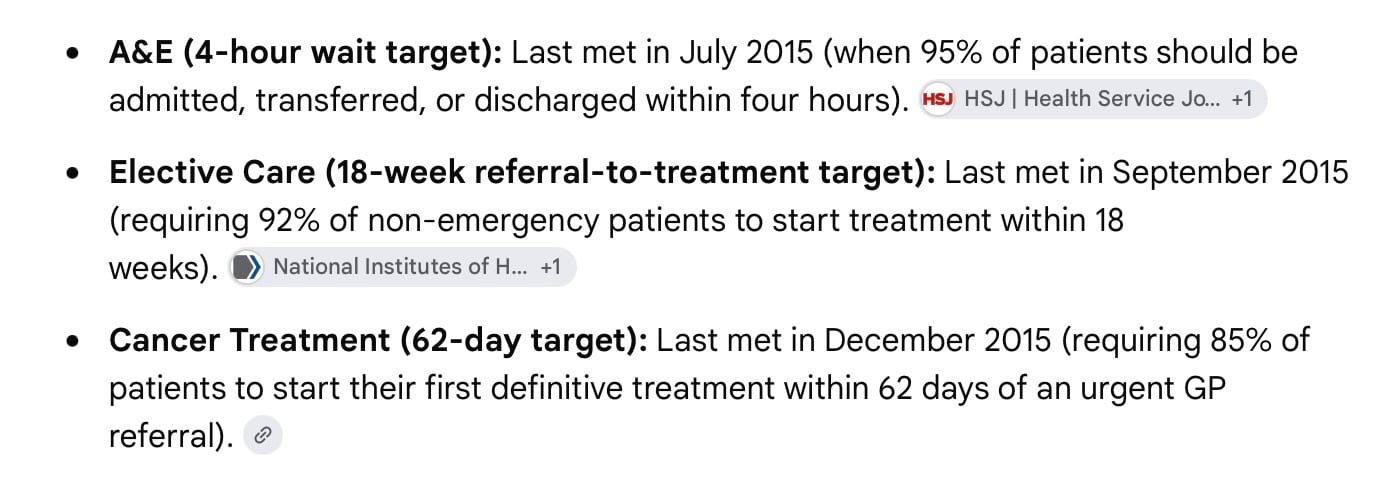
2015-16 was the last financial year when the key national access targets were being met, as this report from the Institute for Fiscal Studies notes. It was also the mid-point of the decade of the English NHS’s lowest-ever funding growth. Entropy was bound to be increasing by this point, as Maxwell’s Demon could have told us: the Second Law Of Thermodynamics is hard to defy.
The Lansley reforms and the austerity decade were responsible for NHS England chief executive Simon Stevens (2014-21) expending huge amounts of his time and political skill in successfully eking out funding increases and moving the English NHS system away from the market theology of dear old Lord Lansley by dint of ignoring the 2012 legislation, and towards a more integrated approach.
In this August 2015 interview, Simon Stevens told me that "our future lies in networks and health systems, not individual go-it-alone institutions ... a circle has to be squared here, between ensuring proper organisational autonomy and accountability; while also ensuring that the broader NHS acts more as a system. We need to be more than the sum of our parts.
"As I say, our future lies in networks and health systems; not individual go-it-alone institutions. On too many procurement and workforce issues it has felt the opposite of that. That’s going to change."
Mmmmmmmm. As I wrote in 2015, “Simon Stevens has an elegant solution to … legislative inhibitions and confusions. He simply ignores the shit out of them; acts as if they were not there; and dares anyone to do anything about it”.
The extent to which Simon Stevens was demonstrably in charge at that time remains remarkable. I would surmise (without knowing for sure, since it was before my time) that among Simon’s predecessors, only Alan Langlands had comparable levels of control over the system and political acquiescence to his leadership.
Here is a 2016 column that the late, great health economist Professor Alan Maynard wrote for Health Policy Insight, on the need for NHS activity and performance measurement to improve significantly. Little of it would have to be changed if Alan were writing it today.
There seems scant value in re-litigating the Amanda Pritchard leadership period, but my thought to write this piece was driven in part by this curious video that she made in her new-old job, talking to Guys and St Thomas’ staff about the need for financial savings. Trying to describe its content and tone, I can’t avoid the word ‘infantilising’. If somebody thinks that the best way to talk to their staff is as if they were a children’s TV presenter and their staff were remedially stupid (as Ms Pritchard seems to here), then it tells us quite a lot: none of it good.
It reminded me of the Victoria Atkins ‘Vic And Bob’ videos. And nobody needs to be reminded of those.
There is a separate but related question about why notably high-performing NHS provider organisations get into trouble so quickly, often if not usually when their leadership changes. Whether it is Salford Royal/Northern Care Alliance, University Hospitals Birmingham or Western Sussex/BSUH, the speed of downfall has been shocking. The same thing happens at recently turned-around trusts, such as Morecambe Bay: more recently, MerseyCare has found itself in trouble. The inevitable problems of mergers/takeovers plays into this, but it’s not the whole story.
Some of the increasing unease post-2015-16 is definitely about the impact of austerity. The cumulative impact of post-2010 capital-to-revenue transfers has left us with a vast unpaid and unscheduled backlog maintenance repair cost: £16 billion and rising. The Wild West of maternity services is not helping: nor is the huge cost of clinical negligence.
The wilful destruction of the intermediate tier of strategic health authorities was among the shitter aspects of the Lansley reforms. The regional presences of NHS England have been neither use nor ornament as a substitute. The utter collapse of the Care Quality Commission has not helped matters, either.
And without any doubt, the job of NHS senior leaders and chief executives has always been and still is a very hard one.
But improving operational and system management in the English NHS feels like a low priority, and has felt like that for many years now. And this should worry us greatly. The 2024 Darzi Review could not have been clearer about the need for improvements in system and operational management. Yet very little of consequence and durability has changed.
The Darzi Review observes that “some have suggested that this (the poor state of the English NHS the report describes) is primarily a failure of NHS management. They are wrong. The NHS is the essential public service and so managers have focused on ‘keeping the show on the road’.”
There is truth to this, but it’s not the whole truth. I’m not certain that I have a strong conclusion here. But it seems very apparent that the capability, capacity, quality and value of management in the English NHS deserves considerably greater focus than it currently has.
Recommended and required reading
Intelligent and apparently well-informed piece by Patrick Maguire of The Times on the importance of social care reform to PM Andy Burnham.
“I would worry about any mum feeling pressurised that there is somehow a kind of an ideal birth experience to live up to when it’s always different in every case, and you have to follow the evidence, you have to have informed choice”. New SOS Yvette Cooper Guardian interview confirms that she plans to re-introduce binding national maternity standards. Mmmmmmmmm.
Oh good: another NHS structural redisorganisation - this time, of ICB and cluster boundaries.
Thank goodness AI’s going to definitely save the NHS, eh?
New Hospitals Programme suppliers announced.
HSJ writes up reviews of East Kent Hospitals University Foundation Trust, which found its organisational culture did not encourage staff to raise concerns, and that they lacked confidence these would be addressed. It reported “fragile” confidence in speaking up, and a lack of triangulation when concerns were raised. Several interviewees told report author Helen Buckingham of a “nepotistic culture”, where those who fitted in or had the support of important individuals progressed.
The Financial Times’ ongoing coverage of Palantir and the Federated Data Platform reveals that at least half a dozen senior health leaders in England have been linked financially or professionally to Palantir; and that NHS England intends to modify how it calculates two of its headline figures about the performance of the Federated Data Platform in the next quarterly update, more than a year after the data was first published.
Strange FT non-story about DHBSC permanent secretary Samantha Jones and her husband Milton Keynes NHS FT chief executive Joe Harrison having fully-declared financial interests in private equity firm G Square for which they respectively worked (Jones) and work (Harrison).
Deeply unsettling Guardian long read on freak vascular surgeon Neil Hopper.
Intriguing Times piece on what US hospice doctor Chris Kerr has witnessed in end-of-life visions.