Cowper’s Cut 431: OPEL fruits - made to make your eyes water

We won’t pretend that this has been one of the most consequential weeks for health policy in history, but one or two things emerged.
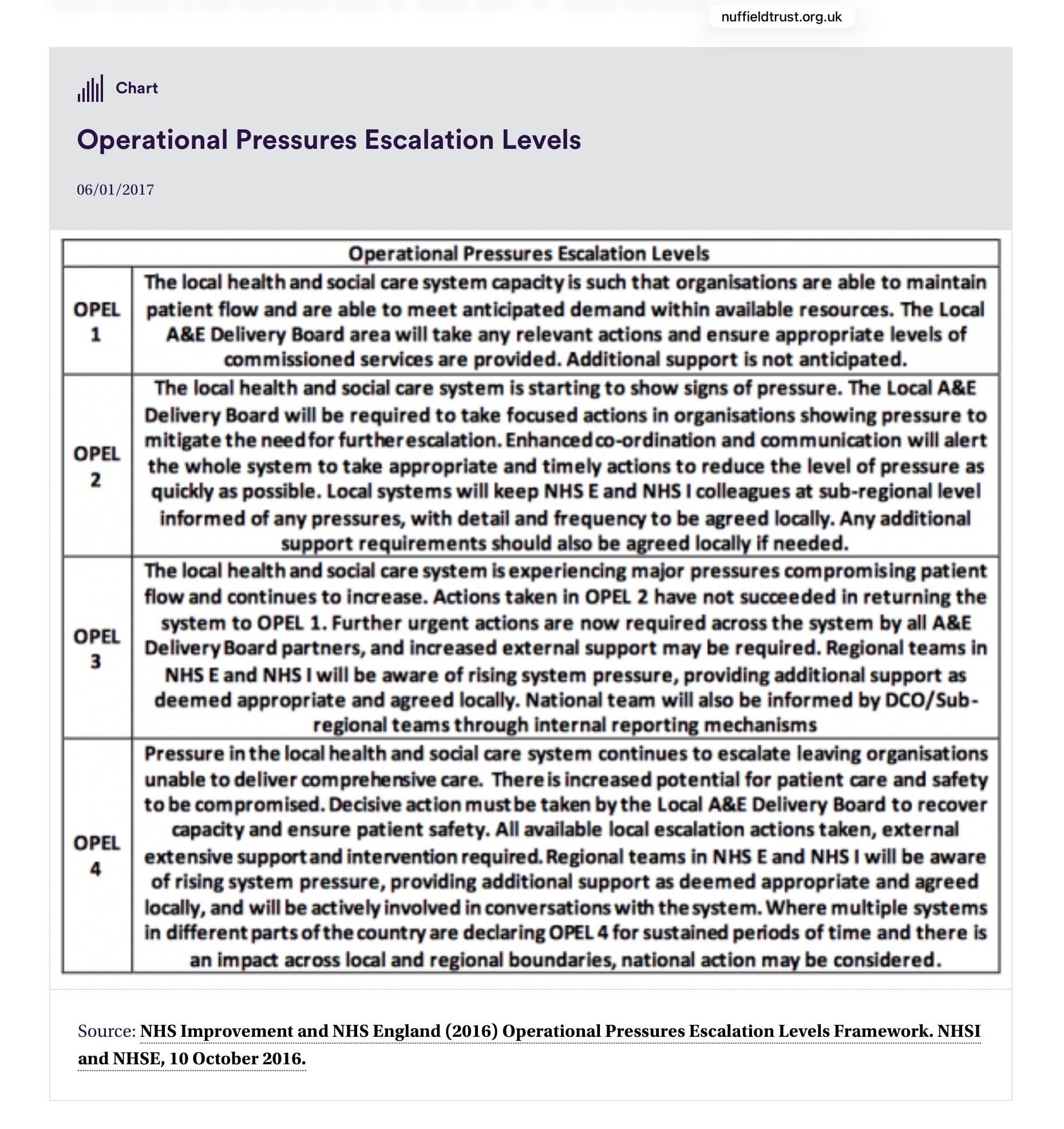
One of my contacts this week revealed that at the height of summer (traditionally, the time of lower demand on NHS hospitals), two English NHS provider trusts are already on Operating Pressure Escalation Level (OPEL) Three, so only just shy of the crisis ‘Black Alert’ OPEL Four.
Ooops.
This implies that the upcoming winter may be more than usually challenging.
As Nigel Edwards pointed out ten years back in this piece for the Nuffield Trust, OPEL data were not even collected until 2016. While we have had subsequently had winter pressure dashboards from the NHS commissioning board AKA NHS England (and the ‘WinterWatch’ initiatives from NHS Providers and the thinktankocracy), the OPEL data for England’s provider landscape are not routinely published.
NHS England’s latest instructions on the OPEL assessment process are here.
The consequence of this is that the NHS’s national system leadership does not seem to have the ability to track which are the most and least resilient provider trusts. That missing ability to track would be how the system and its constituents could learn from what works, and just as importantly, what doesn’t.
But as I have been writing for a long time now in these columns, national-level curiosity about the root causes of NHS performance has for some years now been notable mainly by its absence.
 Emily Townsend
This is a problem, particularly when our current “constellation of ineffective and shit regulatory Death Stars” which assail providers remains neither use nor ornament, as this Health Service Journal piece on the Care Quality Commission’s latest rather public failure reminds us.
 Mr Andy Cowper
I went into this topic at some length in this column last December.
Another interesting observation this week was a comment about the current wave of redundancies in Integrated Care Boards as well as in NHS England: in particular about the NHS England guidance for the current January 2026 iteration of the Mutually Agreed Resignation Scheme.
(MARS, OPEL - has somebody up there got a 1970s confectionary fetish?)
The comment made was as follows: “the MARS scheme seems design to encourage experienced (but often not very senior) admin staff to leave. Do we think this is a good thing?”
We surely do not think that outcome, assuming that the incentives are followed (as incentives usually are) will be a good thing. Isn’t it a good question, though?
Towards cuts to fund defence growth
Somebody in Number 10 Downing Street briefed journalists at the Sunday Times that resident Prime Minister Sir Keir Starmer is planning revisions to the Spending Review, to fund increased defence spending.
The piece reports that PM Starmer “will cut capital spending, which funds long-term investment on infrastructure and building projects, across all government departments by 1 per cent to raise approximately £6 billion by the end of this parliament.
“However, Ed Miliband’s net-zero department and Heidi Alexander’s transport ministry will endure further cuts.”
The news of cuts to capital budgets is particularly unwelcome for an NHS still dealing with the aftermath of the Boris ‘Boris’ Johnson era’s New (If Fictional) Hospitals Programme; the hospitals going to RAAC and ruin; and the £16 billion backlog maintenance bill awaiting a means of payment.
Palantir in the news again
NHS Federated Data Platform contract winner Palantir is once again in the news for less than ideal reasons. The Financial Times reports on a statement from national data guardian for health and social care chief Dr Nicola Byrne, responding to privacy campaigners’ concerns that NHS England was allowing non-NHS staff in of working for Palantir to have ‘administrator’-level access to identifiable patient data within the National Data Integration Tenant past of the FDP programme.
Dr Byrne’s statement notes that she had been told that “access to identifiable patient information would be limited to NHS staff with a legitimate need” and was “not aware” of any change in policy. “We have therefore written to the programme to seek clarification on this inconsistency. We need to be confident that the positions presented to us are accurate, consistent and clearly reflected in public-facing transparency materials”.
The committee’s MPs urge the government to exercise the 2027 break clause in the NHS Federated Data Platform Contract with , and either develop an in-house replacement or seek an alternative UK provider. The report argues that vendor lock-in should not be seen as inevitable, and calls for a strategy to end lock-in across the public sector, diversify suppliers and strengthen digital resilience.
My usual conflict of interest declaration here: I was paid for my participation as a member of Palantir’s Health Advisory Panel in 2022 and 2023.
It was unsurprising to see that somebody pro-FDP had leaked some NHS England memos to The Boris Johnson Fanzine suggesting that the FDP might be able to cut the NHS’s huge backlog by a million cases.
One million, meet the 28% solution
There is a credibility problem over this number.
It is a variant of the same credibility problem that I raised with the Palantir leadership multiple times, in sessions of the Health Advisory Panel and on other occasions: it is that we heard many claims about the 28% waiting list reduction that Palantir’s ‘Foundry’ technology apparently helped achieve (particularly from the demonstrator site of Chelsea and Westminster), which the Financial Times reported rather incuriously back in 2022.
We have just not seen these numbers independently validated or published in any peer-reviewed format.
I advised Palantir that the data validating this claim of a 28% reduction at C&W should be provided to the Heath Advisory Panel, and also published.
It was not.
Palantir’s Indiana Jones Defence
The consequence of this over-claiming and under-proving is that Palantir, a firm with well-known reputational issues, is now relying on The Indiana Jones Defence.
My fellow classical scholars will know that in ‘Raiders Of The Lost Ark’, the protagonist Professor Indiana Jones, who has recently been punched in the face by his ex-girlfriend Marian Ravenwood, deploys the line “it’s important, Marion. Trust me!”
You will also recall that in response to this, Marian Ravenwood immediately tries to again punch Professor Jones in the face.
If you’re going to try using The Indiana Jones Defence, you need to be good at stopping people from punching you in the face, in very much the way that Palantir are not.
If you instead want to read something good about patient data, then I recommend Jess Morley’s BMJ opinion piece, ‘The single patient record: a laudable aim, at risk of mistakes that could derail it’.
Recommended and required reading
The Government is accepting Lord Mann’s recommendations on tackling antisemitism in the NHS.
The Mascara Kid himself, Makerfield by-election candidate Andy Burnham on reforming social care, in The Guardian.
A new report in The Lancet Oncology co-ordinated by Cancer Research UK calls for urgent investment in the UK’s “fragile” cancer services, after a study found more than one in five cases were estimated to have been missed during the pandemic, the worst performance among a group of industrialised nations.
A non-peer-reviewed academic study briefed to The Guardian suggests that NHS hospitals in England ranking highly for empathy ‘have better patient outcomes’.
Given the dangerously bad state of midwifery, I’m stunned that this proportion is not much higher: a quarter of all babies in England are now delivered by emergency caesarean operations.
Robert Colvile in the Sunday Times on all parties’ lack of thinking seriously about the NHS.