Cowper’s Cut 417: Inertia reel
The interim report of the ‘Independent Investigation into Maternity and Neonatal Services in England’ chaired by Labour peer Baroness Valerie Amos arrived this week: it would be fair to say that it doesn’t contain many surprises to those familiar with the Kirkup Morecambe Bay and East Kent Reviews, or with the Shrewsbury and Telford maternity investigation by Donna Ockenden that preceded her current Nottingham maternity meta-review.
The real question is not whether the findings of all these reviews are striking for their congruence. Of course they are, once the interim Amos Review describes “families being disregarded and not listened to during pregnancy and labour, a lack of kindness and compassion, and reluctance on the part of trusts and professionals to admit mistakes and say sorry when things have gone wrong”.
This is wearyingly familiar: almost an echo of Bill Kirkup’s 2022 remarks on East Kent that “the NHS could be much better at:
- identifying poorly performing units
- giving care with compassion and kindness
- teamworking with a common purpose
- responding to challenge with honesty”
Those look very much like the basics, in a service that was capable of learning lessons.
The real question is why have the maternity services of so much of the English NHS been able to get away with atrocious patient care and safety for so long.
One reason is that there has been no serious attempt of any kind to investigate the culture of the maternity profession, and its often poor relationship with that of obstetrics and gynaecology.
Workforce shortages? Let’s confuse ourselves with a few facts.
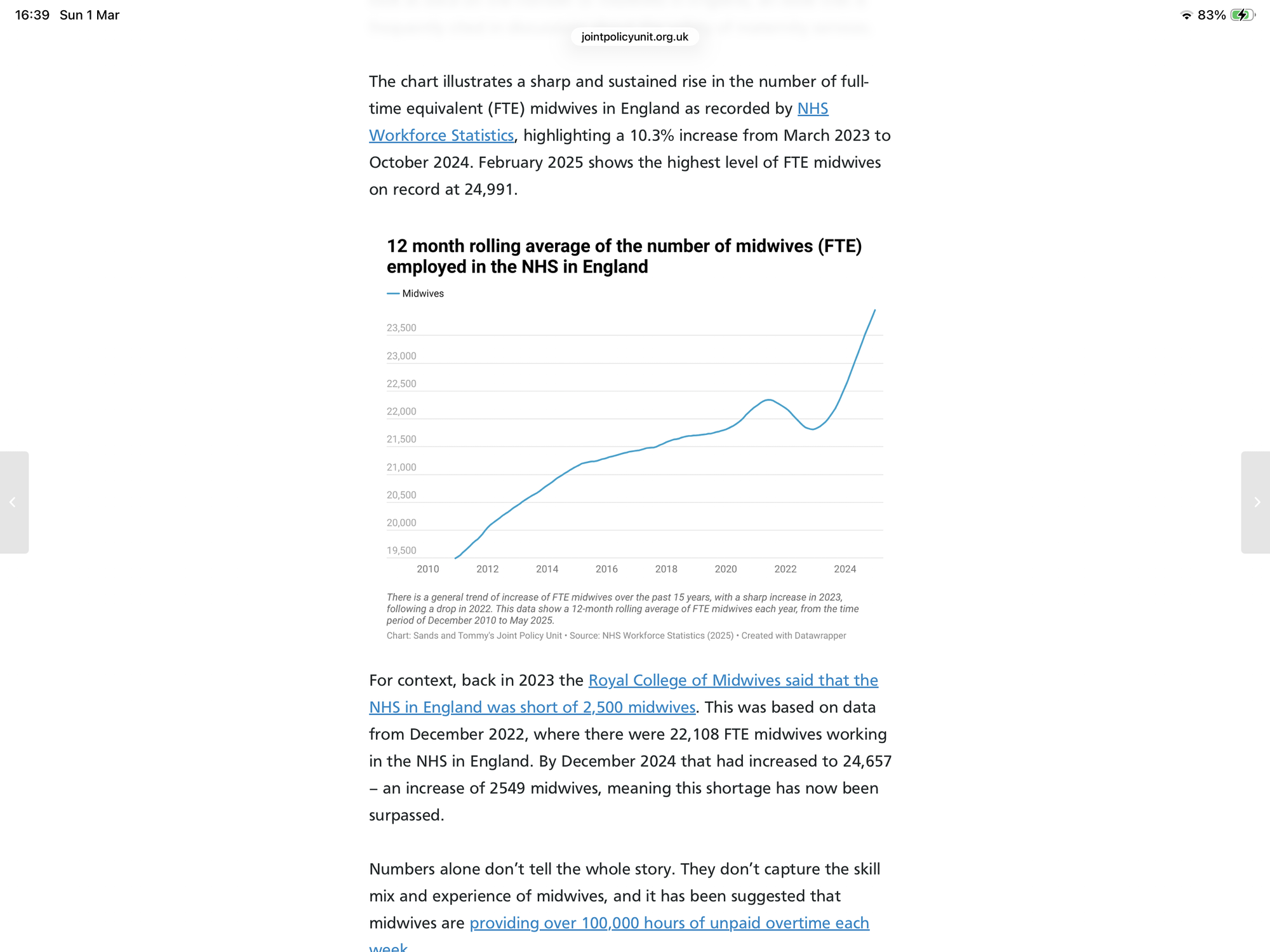
This analysis by the Sands And Tommys Policy Unit highlights significant FTE midwife staffing increases over recent years, following a dip which appears to be triggered by the Covid19 pandemic.
OK. So haw does this correlate to births?
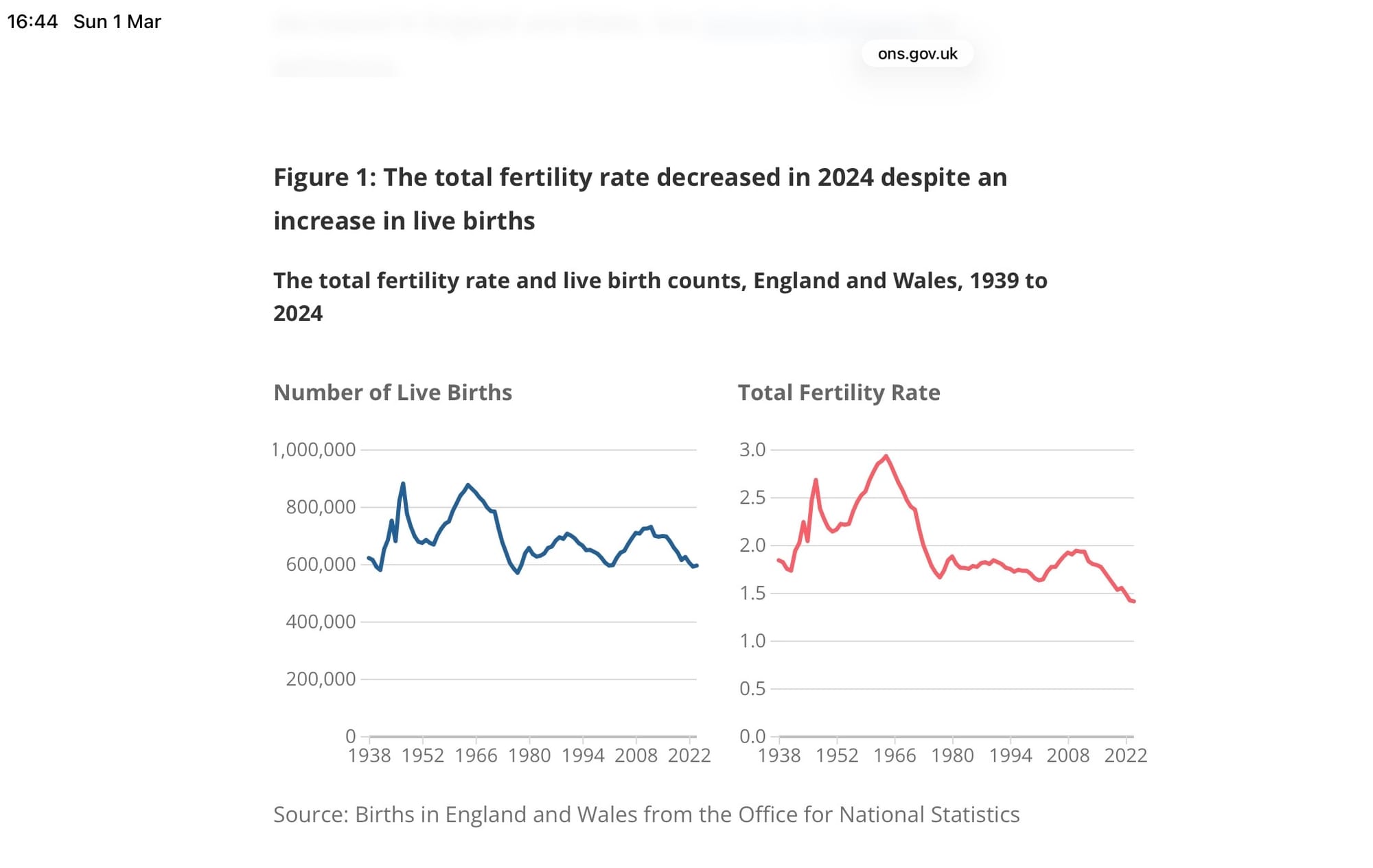
Office for National Statistics data up to 2024 shows that there has been a significant decline in births since about 2010. This does not look like sheer overwork per midwife.
The ONS data does let us caveat this with a things that we already know: that women are generally continuing the trend of giving birth much older.
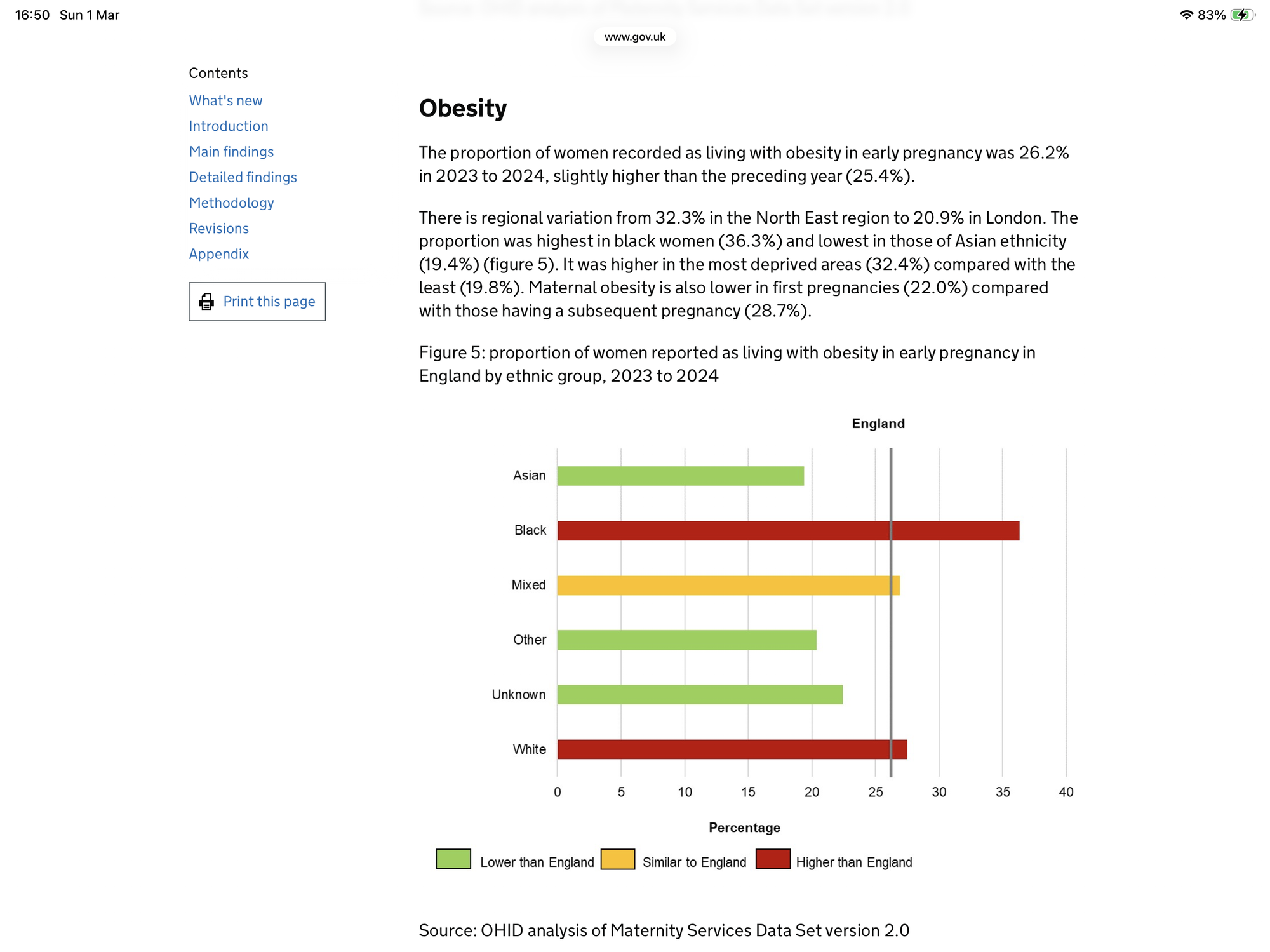
This Office for Health Improvement and Disparities data looks at the impact of obsesity in the maternal population. This is a sizeable problem.
Worryingly, but sadly unsurprisingly, Baroness Amos writes that “of great concern to me are the levels of racism and discrimination we have heard about, exhibited by staff towards women and families, between staff, and by women and families towards staff”.
With yet another hand-wringing maternity review, we appear to be right back on the horns of the major dilemmas facing the NHS in England: the system’s quality and safety regulation is appallingly broken (and has been so for some years); and the national leadership appears to give a grand total of zero fucks about the underlying factors driving good, mediocre or poor performance. There is no curiosity at all on this subject.
As such, it is very difficult to feel any optimism that maternity care is likely to become better or safer any time soon. And in particular, because it looks like an awful lot of terrible performance has become culturally normal; particularly the NHS tendency to get lawyered-up and defensive when patients are harmed.
It is going to require some serious national leadership to start to fix this problem. And that is a big problem, because there quite simply isn’t any.
Maternity care, like mental healthcare, far too often seems to have no inertia reels in place. An inertia reel is a belt-type device, which can move freely but which stops firmly in the event to a sudden impact: the car seatbelt is the most familiar example. Healthcare seems to be poor at designing their equivalents into its processes, and it shouldn’t be.
Young Master Wesley Streeting (again)
 Alastair McLellan
It is without undue joy that I return to the subject of Team Milburn-Streeting. Health Service Journal’s editor Alastair McLellan launched the past week with a bit of a bang, with his editorial calling for the departure of Young Master Wesley, his ’brains trust’ maestro Alan Milburn and Interim Jim Mackey, as the precondition to giving the English NHS a fresh start.
As ‘Cut’ readers know, I don’t disagree with any of the analysis. I have been pointing out the inadequacy or total absence of anything looking like a credible and meaningful plan on Team Milburn-Streeting’s part for the past few years.
Alastair’s cue for the timing was the one-year anniversary of their unexpected announcement of the abolition of NHS England. That’s understandable.
I’m not so convinced by the timing of the ‘must go’ intervention. The week of a three-way marginal by-election in former health minister Andrew Gwynne’s Gorton and Denton constituency (handsomely won by the Greens, pushing Labour into third in a once-safe seat), and the starting in post of new Cabinet Secretary Antonia Romeo, made this unlikely timing for Team Starmer to be rethinking NHS personnel issues.
The Number 10 Downing Street operation is so epically dysfunctional that the (non-)performance of the NHS is at best a second-order issue for them. Naturally this shouldn’t be the case, but it clearly is. It is unclear whether their health advisor Axel Heitmueller has been able to bring any semblance of focus and rationality to the subject.
Young Master Wesley is an appalling Health Secretary. He is evidently uninterested in the brief, save in the ways that it given him opportunities to brief the useful idiots of our political media on what a determined and powerful reformer he is. He is not interested in detail, which is a fatal flaw in anyone who wants to do any serious NHS reform.
I was very struck by one aspect of Alastair’s editorial: he reports having asked Young Master Wesley “whether he thought the NHS was under-managed in the week before the general election. We have never reported his answer for reasons that will become apparent – but now seems like the right time to do so.
“The soon-to-be health secretary said he was constantly presented with evidence for the claim the service had too few managers by think tanks, NHS leaders, and others. But – at the same time – he said, most NHS staff and members of the public he talked to believed the opposite.
“His suggestion was that while that belief existed, the case for management resource remained unproven. He gave no indication that he thought this belief was founded on ignorance or that he saw it as his job to challenge it, regardless of any evidence he was given.
“This is populism, pure and simple”.
It is indeed. But the decision not to publish these comments at that time was a very curious one.
Mr Streeting’s superficial nature could scarcely be clearer than in this silly little piece about ‘fixing the front door of the NHS’ he or his team wrote for the Boris Johnson Fanzine this week. The Boris Johnson Fanzine abandoned any pretence at being a serious media organisation almost a generation ago. For Young Master Wesley to use its platform to assert that “we’re bringing back the family doctor as a central part of community based health services” is farcical stupidity.
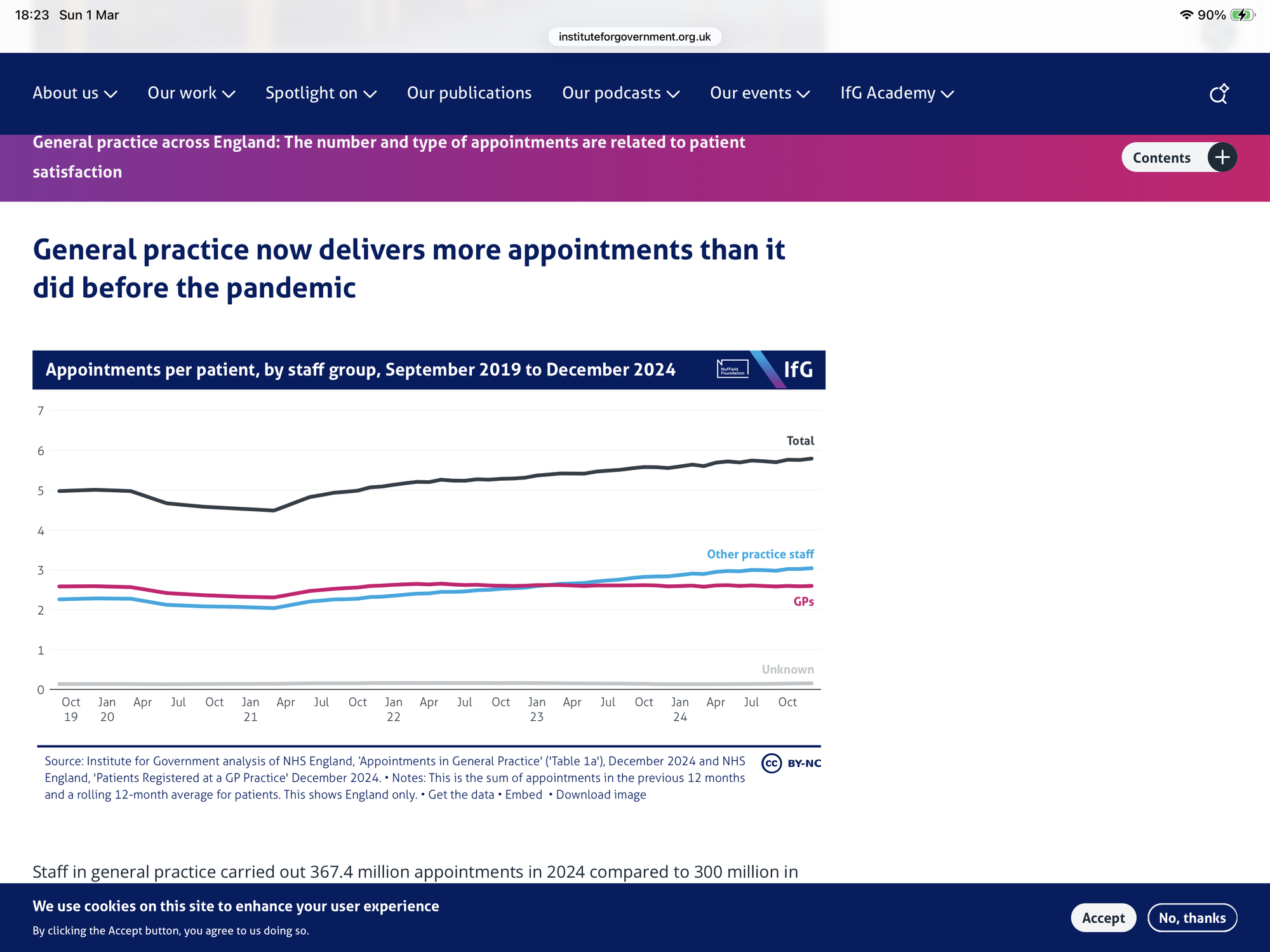
There are some sensible things in this updating of the GP contract for 26-27, but for YMW to be claiming he has a big plan to “fix” the sector of the English NHS which has hugely increased its productivity over recent years is laughable.
Big problems remain, as the latest Health Foundation/Ipsos research shows. It finds that “nearly half of people who had a health concern in the past 12 months avoided or delayed contacting their GP, raising concerns about unmet need”.
Anyone serious should read Zhao, Meacock and Sutton’s recent research on the post-poandemic drivers of primary care demand, as well as The Strategy Unit’s 2024 analysis and the Institute For Government’s 2025 work.
Strikingly, this wasn’t even the funniest thing that Young Master Wesley had committed to the media this week.
 Sienna Rodgers and Zoe Crowther
I commend to all fans of bathos this profile of YMW from the usually-much-better Politics Home. It contains some of the most obviously-briefed Team Streeting blather imaginable, including an achingly funny section which outlines how very early in the morning he gets up to go to the gym before work.
Other parts give us Streeting’s Special Advisors demonstrating just how very un-special they are, such as the one reported saying: “He has struggled to get his priorities through. He’s a very sharp guy. But when he came in, after getting his own way on policy in opposition, he was shocked about needing Treasury sign-off ... It was a rude awakening.”
Rude awakening? Anybody, be it Streeting or SpAd, who did not know that Treasury sign-off was required for rather a lot of things, is simply unserious.
So too is the section which tells us that “sources say his interest in the media has produced tangible change, perhaps his most solid win so far: a transformed DHSC communications operation. It was “so inept, so stuck in the noughties”, says one, whereas it is now video-led, quicker off the mark and better at turning dense statistics into usable lines”.
The DHBSC media operation still sucks, because it doesn’t actually have any credible messages. Whether it uses TikTok is not the point of difference.
Liberation theology
 Mr Andy Cowper
I mentioned a few weeks ago NHS England chair Penny Dash’s comic denial that the national operational leadership is centralising things.
 Emily Townsend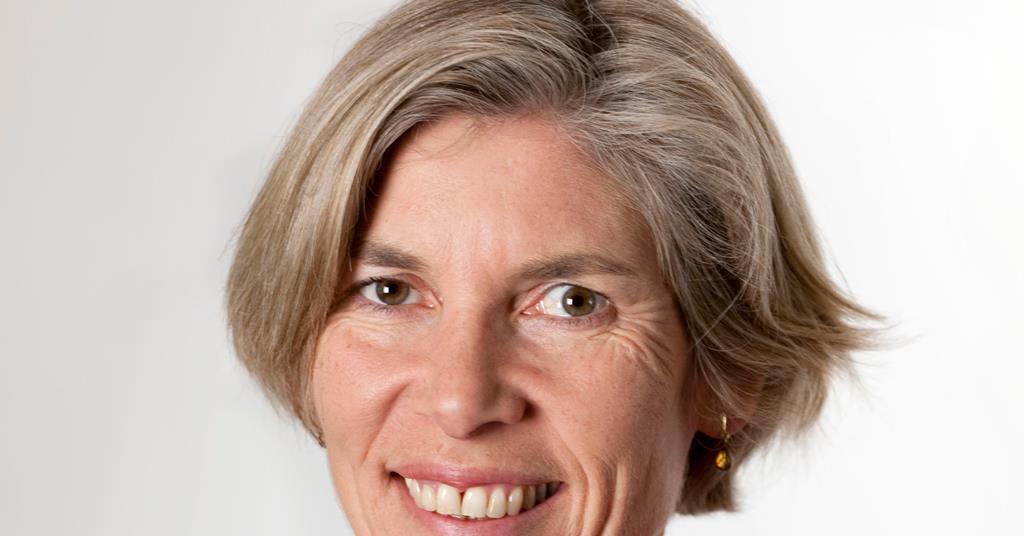
La Dash was at it again this week, with HSJ reporting that she told a patient safety conference that “we don’t want to be overly mandating – there are real negatives of mandating too much … We are trying to avoid, move away from telling every single part of the country how to work”.
I mean, it’s a point of view.
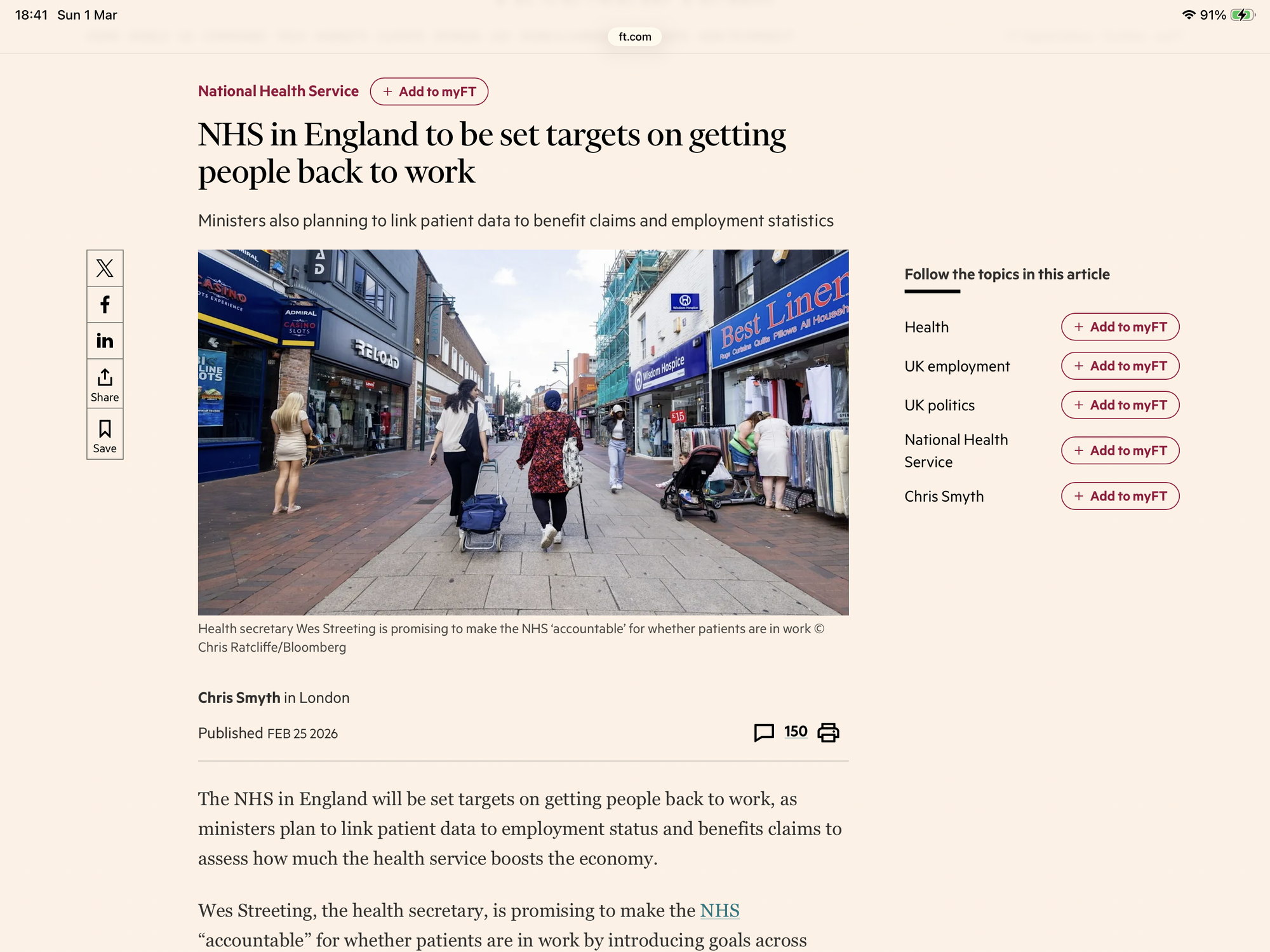
It’s just quite a curious one to air in the week when new FT public policy editor Chris Smyth has this story about the NHS in England being set targets on getting people back to work.
Not to mention the fact that ‘Cut’ readers in NHS leadership roles will be required to dial in on a call on Monday morning to be briefed about ‘priorities for March’.
Recommended and required reading
The FT’s Anjana Ahuja has this useful summary on what the Grail trials for early cancer diagnosis with the ‘Galleria blood test have and have not achieved.
FT again: a fascinating first-person account of a year on a cancer vaccine trial at London’s oldest hospital.