Cowper’s Cut 447: Is it all not going terribly well, then?

Don’t look now, but people in and around The Mascara Administration might finally be starting to notice that median performance in the English NHS is not really improving, what with the RTT backlog rising yet again; and is certainly not improving fast enough to get back to 92% RTT 18 weeks performance by 2029, as the last Labour manifesto pledged.
It’s even conceivable that this may cause these people to notice that there is nothing whatsoever by way of a credible plan to improve English NHS performance, or indeed any credible plan overall. (Whatever impact the long-running and well-intentioned Getting It Right First Time programme was going to have on improving English NHS performance, it has had by now.)
Who knows: these people might even spot that there is something of a national leadership vacuum in the English NHS, and that having an interim national chief executive at the helm (in the shape of NHS England boss Interim Jim Mackey) is probably also sub-optimal.
This may be excessive optimism on my part. (I know: it’s a character fault of mine.) Team Mascara would need to be both curious and willing to find problems that are hiding in plain sight. Denial is not just a river running through Cairo.

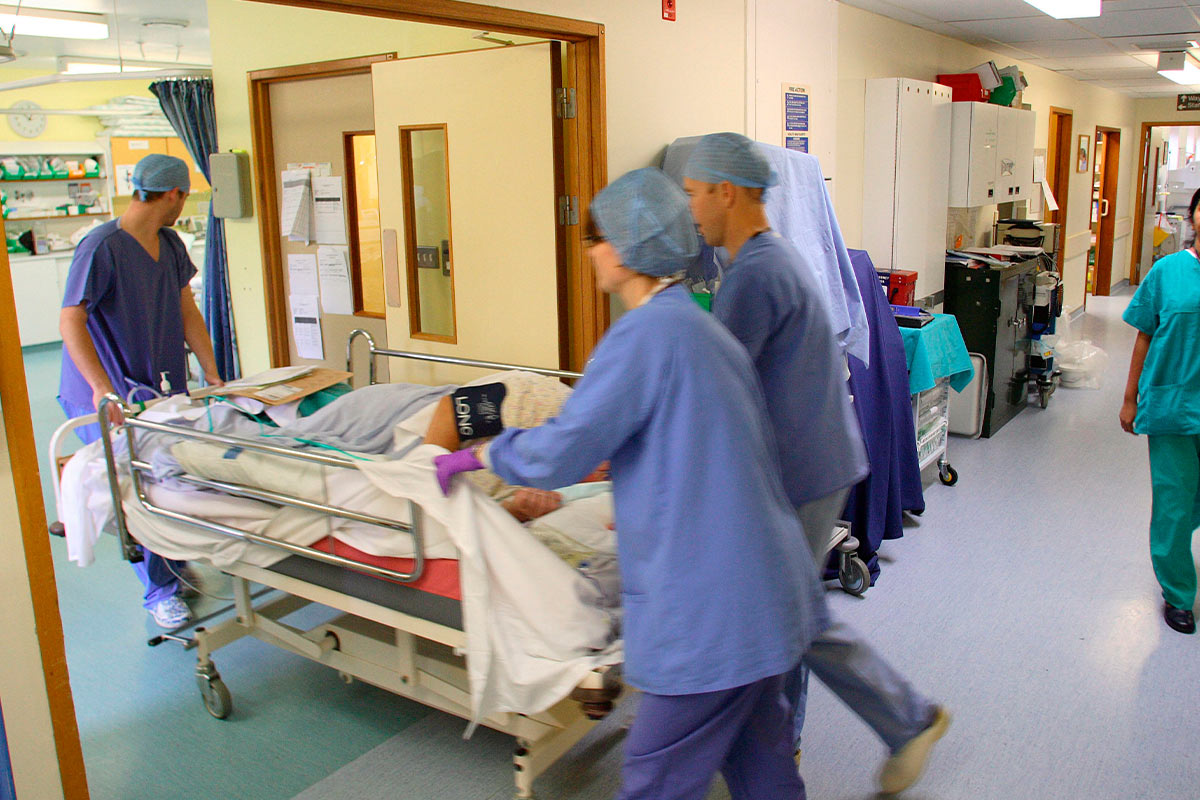
But if there is an inflection point approaching, then some credit will be due to the forthright new report from the National Audit Office that arrived this week. ‘Managing The Flow Of Patients Through Hospital From A&E’ tells us little that we have not known for many years, but it does so a) clearly, and b) now - in the early days of a new Government.
Both matter.
The NAO report’s broad conclusions are unarguable: “the NHS is beginning to improve the performance of A&Es after the severe impact of COVID-19, but improvements have been smaller and slower than hoped. Patients are still waiting too long for the emergency care that they need. NHSE has made significant investment into A&E, but so far this has only resulted in modest gains, with the result that spending has grown without achieving equivalent improvements for A&E patients. This may indicate that the solution is not only a question of more resources, but also how those resources are deployed.
“Experience to date suggests that, alongside efforts to provide care in alternate settings, success also rests on the need to effectively manage patient flow throughout the whole hospital system, enabled by electronic patient record systems and strong leadership.
“The NHS will not meet the overall A&E performance standards without very substantial improvement in many Type 1 A&Es. Such improvement will require systemic intervention. Some of the main reasons for slow flow are in the control of hospitals themselves, but there is also significant potential with better integrated support for patients leaving hospital.”
All of these points are: 1. correct; 2. well-known to members of The Reality-Based Community; and 3. not even remotely the central focus of either NHS England or the Department For Health But Social Care.
And this is a problem. Indeed, it is quite possibly THE problem.
Not is it new. Currently (indeed for several years now), the English NHS national performance management regime can best be described as ‘bystanderism’.
BYSTANDER ONE: “Ooh look! The NHS in England’s performance is objectively fairly poor and getting worse, which is avoidably harming patients and making it a shit place to work.”
BYSTANDER TWO: “Oooh, you’re right!”
BYSTANDERS ONE & TWO IN UNISON (AND PERHAPS OTHER TRADES UNIONS): “Isn’t it awful?”
BYSTANDER ONE: “Should we … do something?”
BYSTANDER TWO: “Sounds risky.”
BYSTANDER ONE: “I see what you mean. What if we tut audibly, to show our disapproval?”
BYSTANDER TWO: “Careful! People might hear us: then where would we be?”
BYSTANDER ONE: “Oh. [pause] Do you think it just needs some more applause?”
This is not, by the way, meant mainly to have a go at Interim Jim Mackey. He agreed to take the hospital pass of succeeding Amanda Pritchard as NHS England CE, which was courageous: this included the non-negligible and thankless task of re-establishing financial discipline.
Sir James has been a fiercely effective chief executive of the trusts where he’s worked. He is evidently a very effective operational leader at trust level.
The point is that he is not a national leader: nor did he want to be either the first time around at NHS Improvement, or indeed this time.
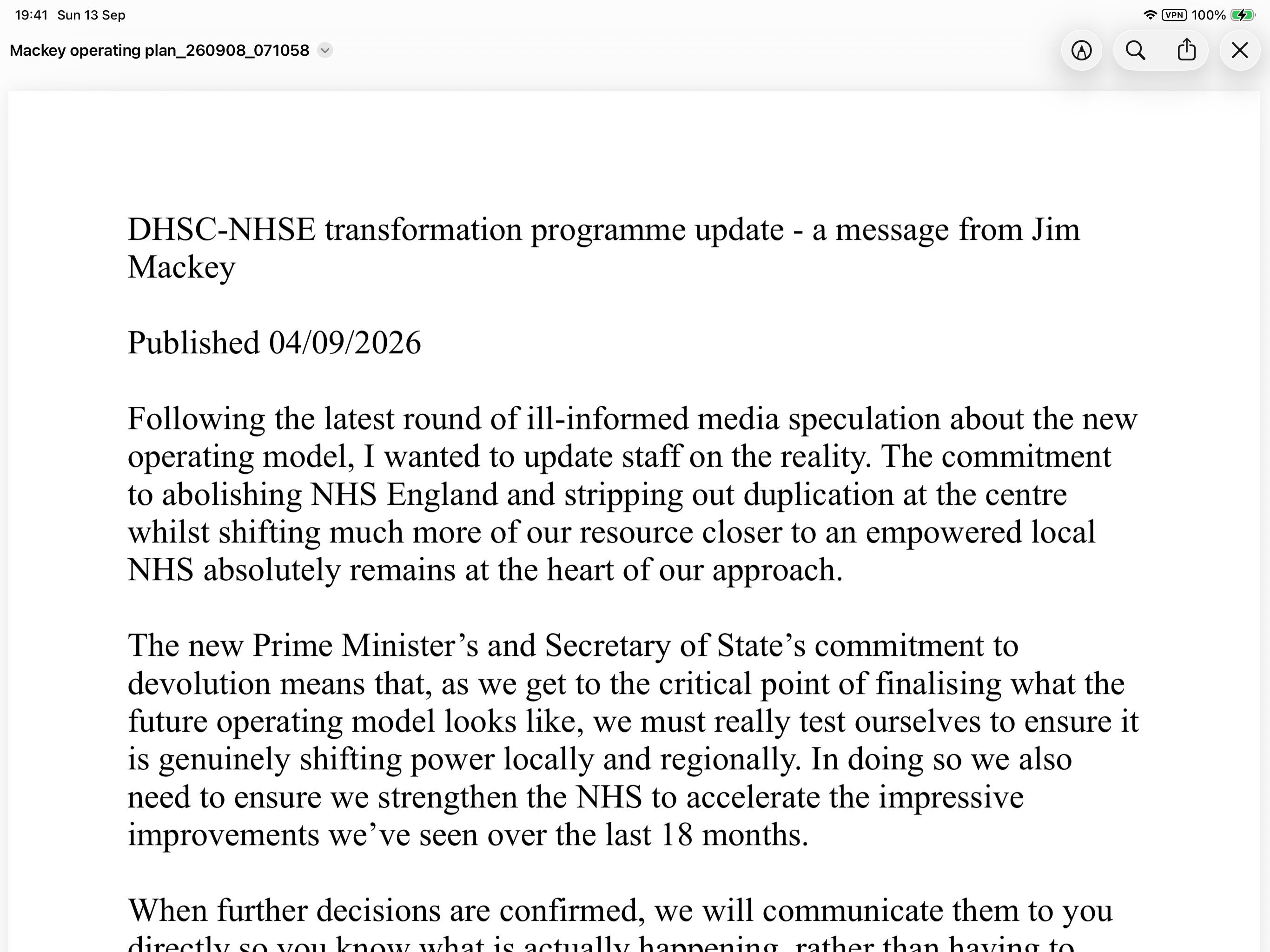
I was entertained by Sir Jim’s choleric communication last week about the reports of DHBSC civil service infighting over the importing of NHS England staff, as covered in last week’s column.
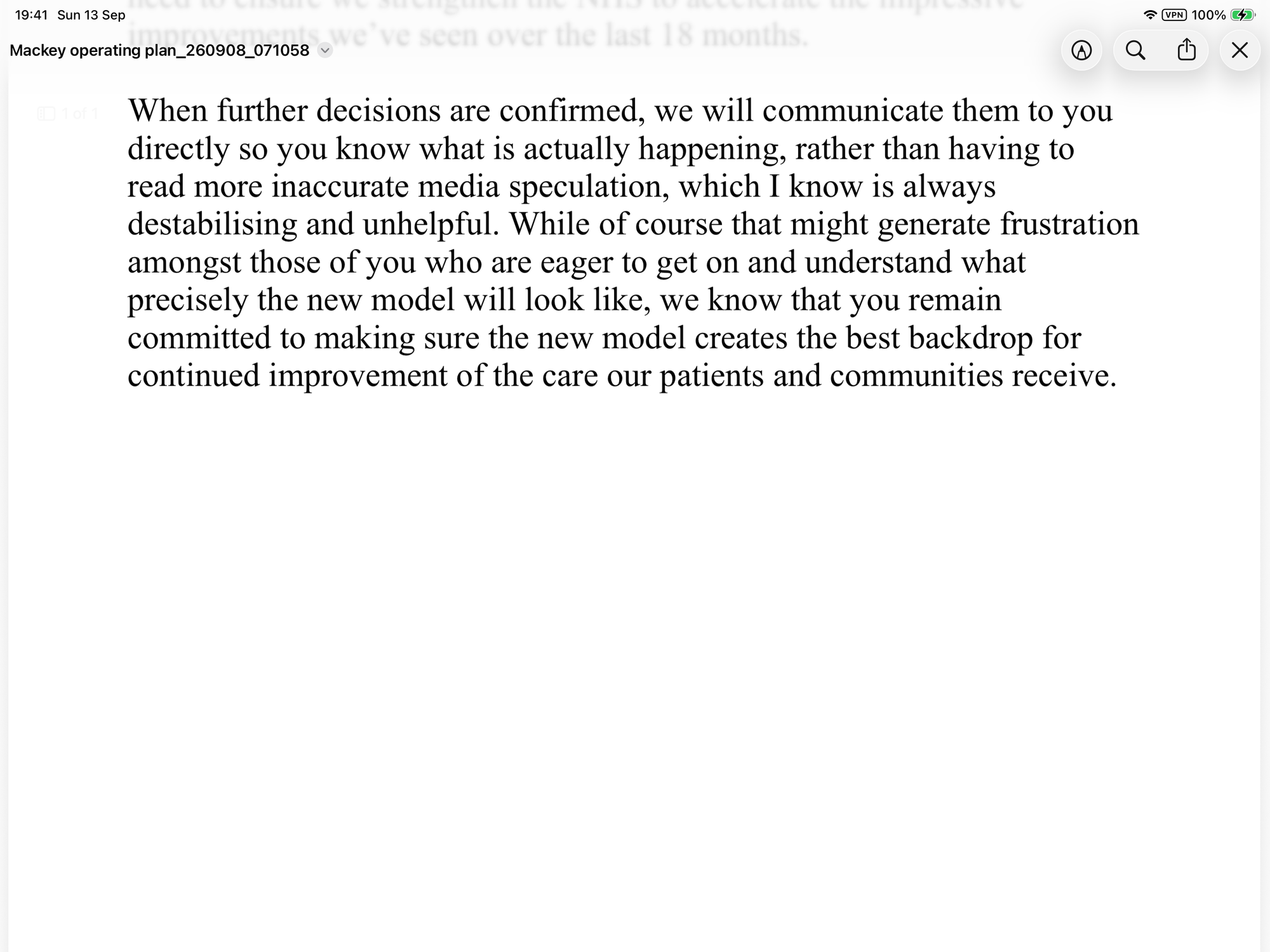
As NHSE health policy communiques go, it was a bit of a marmalade-dropper: “following the latest round of ill-informed media speculation about the new operating model, I wanted to update staff on the reality … When further decisions are confirmed, we will communicate them to you directly so you know what is actually happening, rather than having to read more inaccurate media speculation, which I know is always destabilising and unhelpful.”
Oh dear, Rob Checketts. Oh dear, oh dear.
Sir Jim’s peremptory note describes the “need to ensure we strengthen the NHS to accelerate the impressive improvements we’ve seen over the last 18 months”, but it does not outline what these improvements are.
 Dave West
Dave West’s observations in his latest column for Health Service Journal carry decent weight of observation. On the4 ‘who’s in charge’ dilemma, Dave rightly notes that the likely outcome is one of “NHS CEO keeping permanent secretary status and leading an “NHS executive” operating within the department. That was roughly the pre-2012 compromise, and it looked a fairly obvious landing point from the outset. As ever, however, its success would depend on compatible personalities and approaches at the top.”
Ahem.
Dave’s piece neatly outs the massively-confused or just plain absent thinking over the tensions between policy moves driving centralisation versus the policy moves/rhetoric driving devolution (about which so much of these columns have written over it past few months): “it is now being questioned whether the NHS, alone among public services and government departments, needs such a hefty regional tier. NHS regions will inevitably clash with the role of mayoral authorities that want a role in the NHS. Indeed, in the case of Greater Manchester it already has”.
Oh dear.
There remains an heroic lack of clarity about what national NHS politicians and policymakers want to achieve from both centralisation and decentralisation. In consequence, it is not surprising that the left hand does not seem to have a clue what the further-left hand is doing.
“NHS England was formed out of backside covering.”
Ex-Health Secretary Wes Streeting, Boris Johnson Fanzine 15.3.2025
Following the revelations covered here last week about the potential replacement of independent QUANGO NHS England with another QUANGO because DHBSC civil servants can’t be arsed to do their jobs, it was amusing to see that Health Service Journal’s Zoe Tidman went through the latest NHSE annual report and accounts to work out what the pay-offs had been to former NHSE executive board members.
 Zoe Tidman
It’s quite something, when we remember how these departures were presented to us at the time of their happening. Still, nice work if you can get it.
Recommended and required reading
This new survey from The Royal College of Emergency Medicine (RCEM) finds, unsurprisingly, that understaffed and overcrowded emergency departments contribute to increased attacks on ED medics. 63% said they had suffered discrimination (including racism, sexism and homophobia): 73% reported that violence or aggression of all kinds was a daily or weekly occurrence. Almost all (96%) said they had experienced abuse from patients or members of the public.
The public sector situation regarding the 2023 Nottingham mental health serial killer gets worse and worse: The Times reports that the perpetrator researched bomb ingredients and searched online for large public venues, but that this evidence was hidden by police for three years. The material was found after the June 2023 attacks: Nottinghamshire police deemed it to have no evidential value and did not disclose it. It was only provided in recent weeks, after the conclusion of evidence hearings in the public inquiry, because lawyers for the bereaved families noticed a reference in a police statement. The notes, relevant to the perpetrator’s mindset and capacity before he fatally stabbed three people and seriously injured three others, were also not given to psychiatrists who assessed his culpability.
Spire Healthcare, Britain’s biggest private hospital operator, has agreed to a 250p a share offer by an investor group led by Toscafund Asset Management, which values the business at £1.03 billion, The Guardian reports.
New shadow health secretary Damien Hinds writes on the returning assisted dying legislation for the Boris Johnson Fanzine, criticising its ‘auto-commencement’ clause and highlighting how the proposed Bill explicitly allows ministers to alter the founding principles of the NHS, citing Simon Stevens calling this “a Trojan horse clause for fundamental change to the National Health Service by the back door”.
And there I was, writing that an “important subset of the ‘centralisation vs. decentralisation’ dialectic is this: what happens to all the bad mergers?” Ahem.
 Zoe Tidman
Moderately fun Nuffield Trust piece observing that things are not going well.