Cowper’s Cut 446: Millyexit, or “human kind cannot bear very much reality”

Let’s start with a rare bit of good news: Alan ‘Milly’ Milburn is on his way out of the power structures in the Department For Health But Social Care. It’s not yet officially written down, but the direction of travel is explicit.
Mr Milburn is moving swiftly on to his next mark, which is that of pretending to have a solution to the problem of young people not in education, employment or training: NEETs. Good luck, young people: it’s not as if you’re the future of our nation, or anything important … oh.
There will be a lot of relieved people in the DHBSC, although none of them will be NHS England pro tem chief executive Interim Jim Mackey, whose Milburn Bromance will now have to be conducted on their own time.
It’s a shame that nobody in positions of power has paid any attention whatsoever to the fact that Milly’s tenure back in charge, both as DHBSC lead Non-Executive Director and as erstwhile controller of his amaneuensis Young Master Wes Streeting, has been an unambiguous failure in terms of delivery.
The performance of the English NHS is in no danger of meeting the 2024 Labour manifesto commitment of getting back to 92% performance on elective 18-week RTT, let alone all the many other massive delay areas.
The NHS maintenance backlog is in absolutely no danger of being addressed, as Shaun’s report yesterday about maintenance chaos at charitably well-endowed GOSH emphasises.
What? You mean we have to do things about having abolished NHS England?
But amusing as it was, Millyexit wasn’t the funniest health policy story of the week.
Both The Times and Health Service Journal spread the joyous news that enormous quango NHS England may well ultimately be abolished on schedule in April 2027 to be replaced by - drum roll! - another enormous yet-to-be-created quango.
No, seriously.
One must have a heart of stone not to laugh.
This is apparently because DHBSC civil servants have advised ministers that matching the pay, terms and conditions of NHS England’s staff once rolled over into DHBSC on civil service contracts will be ‘not straightforward’.
As regular ‘Cut’ readers will have noticed, I am not a minister: you will probably have concluded that this may well be for the best.
But if I were a minister, I think my response to this blatant, lazy civil service protectionism would have been along the lines of:
- This was announced as a major piece of Government policy nearly 18 months ago. If you, dear DHBSC civil servants, failed to plan adequately to deliver this in the past year-and-a-half, then we might need to review with some urgency the scope of whom we should be making redundant. Yes, that indeed means you.
- In the event of the meaningful blocker to change being the pay disparity between senior NHS managers and civil servants, then there is this tremendously useful and longstanding thing in employment law and practice which already exists, called ‘job matching’. So you do that. Unless you can offer any valid reason why not?
The HSJ coverage suggests that one person involved in discussions said, “we can’t have a centre completely dominated by civil servants … so we need to find a way to maintain some [NHS] capability”. This feels like being offered a dinner menu option of shit with mustard, or shit with jam: the choice is theoretically interesting in the abstract, but you don’t actually want either of them. (Certainly, I don’t.)
The Times piece reports that “Yvette Cooper, the new health secretary, was warned by officials that the initial plan was unworkable because NHS England staff had far better pay and conditions than counterparts at the Department of Health”.
I mean, yes: there is an un-mysterious reason for that.
NHS England used to genuinely be in charge of the show. It was where anybody ambitious wanted to work, and it metastasised from the NHS Commissioning Board into NHS England The Big And Ineffectual Meetings Monster as other bodies were (unwisely) folded into it.
This was all very obvious if you were not stupid, and indeed it has been explicitly written down in these columns for the past several years.
“human kind / cannot bear very much reality”
T S Eliot’s ‘Four Quartets’ is a dense poem about religion and theology, and quite a bit else. Like much of Eliot’s work, it has some great lines in it, and “human kind / cannot bear very much reality” has been resonating pretty hard with me about English health policy and politics for some time now.


Anyone who saw Mascara Kid and PM Andy Burnham’s Commons debut this Tuesday would have noticed a little light mentioning of social care reform (now firmly on the 2027 agenda, at the earliest), but no mention whatsoever of NHS improvement or reform.
(That session also saw pro tem Conservative leader Kemi Badenoch, in her questioning, assert that “we Conservatives are for the future, not the past”, but perhaps we should not intrude on private idiocy as to your actual core brand.)
The following day’s PMQs saw Mr Burnham admit, in response to questions from Lib Dem leader Sir Ed Davey about the maternity closure situation in Devon, that “there are structural issues affecting maternity services across the UK. This is not the only hospital where there have been difficulties. As a former Secretary of State for Health, I am aware that there have been long-standing shortages of midwives across the country. It is right that we look at all those issues. I can give him a guarantee that my right hon. Friend the Health Secretary is looking at those issues following the recent maternity reviews.”
So, English NHS maternity care: an area rich with crisis and scandal for over a decade now, and the new Government’s proposed solution?
A guarantee of a look by the new SOS, following a review.
This is many things, but none of them is serious health policy and politics.
The lack of debate and thought about NHS reform is as striking as it is worrying, and it is very striking. The public has massively noticed the deteriorating performance: 26% of those surveyed report being satisfied. Yes, this is a bit of an improvement on the previous year’s data.
The concern is this: the English NHS has become a hybrid between the elephant in the room and an ailing National Treasure, trading on past glories. Nobody wants to talk about it, and nobody knows how to fix it.
“Don’t mention the state of the poor old dear. That’s not nice, and besides, it used to be good!”
“Well, yes, but it’s just shat on the floor again. A big, messy elephant shit. And it stinks. And the mop is broken since last time it was cleaned up.”
“Why do you hate the NHS? You want privatisation and America, don’t you?”
“Erm …”
You say you want a devolution, well, you know: we all want financial balance
 Dave West

Since The Mascara Kid became our next PM, I have been pointing out that the dynamic between his apparent love of devolution and the rampant centralisation that has already happened and is continuing in the English NHS would be worth your attention.
This week, HSJ reported that Salford’s pooled Better Care Fund budget, which totalled £335 million in 2024/25, is forecast to be just £85 million in 2026/27, according to planning data published by NHSE this month.
Salford Integrated Care Organisation was launched in July 2016 as a partnership between the council, Salford Royal Foundation Trust and Greater Manchester Mental Health FT: its creation was supported by NHS England “vanguard” funding. It saw council staff and contracts transferred to the trusts and most adult social care functions delegated under two Section 75 agreements.
The initiative was one of several borough-level integration models developed within Greater Manchester during its “devo manc” period.
Devo-Manc, you say?
There’s a new Conservative Shadow Health Secretary, apparently
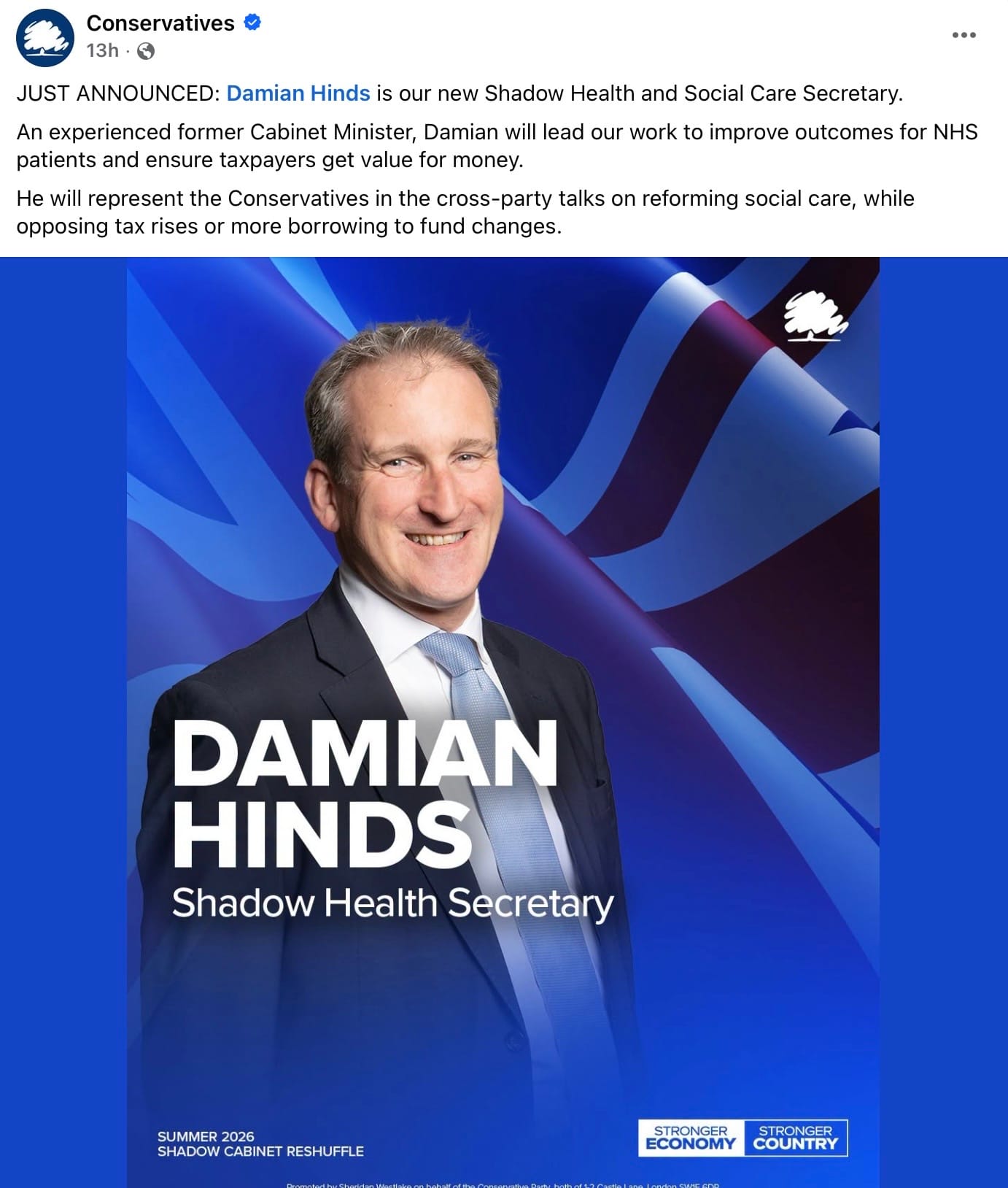
Well, Stuart Andrew came and went as Conservative Shadow Health Secretary without once meriting a mention in these columns.
His replacement in the role is Damian Hinds: another apparently cut from the same ‘not even a household name in your own household’ cloth. One senior health figure who has met Mr Hinds in real life describes him as having “the presence and enthusiasm of a dead cat”, which will be a fascinating new energy to bring to the role.
A more cynical human than myself might speculate that (once again) it feels like this is the result of having asked AI to create the CV of a nondescript middle-ranking Tory MP.
It doesn’t quite scream ‘hey, we can make some political headway and possibly even capital on this underperforming major public service!’, does it?
Recommended and required reading
Welcome honesty from Dr Sarah Hughes of MIND: “we, as a charity sector, have failed to acknowledge that violence does happen in some circumstances. As a sector, [we] have held the narrative that the majority of people don’t commit violent crime. However, some do - and the consequences are grave.
New research published in the Journal of Translational Medicine, led by the University of East Anglia and Oxford Biodynamics, suggests there is “a biological unifying theory of fatigue”, The Times reports.
The Times also reports on an observational study by researchers at The Christie which finds that giving cancer treatment in the morning rather than the afternoon could help improve survival chances.
‘The Man With The Plan’, a new film about William Beveridge and his key report, is touring.
The Palantir-provided Federated Data Platform ‘is here for the long term’, says NHSE leader probably not here for the long term.