Cowper’s Cut 406: Short selling

“I feel like since we’ve come into Government, we’ve actually done a huge amount that we said we’d do … But that’s not reflected in the polls, and I don’t think it’s even reflected in our storytelling. I think we sell ourselves short.
“Labour performs at its best when we are a party of both the Left and the centre. We’ve got to be a party that is about investing in public services, but also modernising public services so they change with the times and meet changing needs in our society.”
Health But Social Care Secretary Wes Streeting, interviewed in the New Statesman
It is a fascinating tell that Health But Social Care Secretary Wes Streeting thinks that Labour have been both selling themselves short and failing to tell their story. Short selling is a simple process, whereby investors “seek out companies whose shares they believe to be overvalued, whether by market exuberance or outright fraud”, The Economist explains. It’s perhaps not the best of metaphors: more of a meta-against, really.
In Young Master Wesley’s own remit, it is hard to see what concrete achievements have been delivered. This is unsurprising, given that Labour overall (and Team Milburn-Streeting in particular) did not prepare adequately for taking office.
I wrote in June 2024, the week before the General Election, that “we know very little (other than headlines and vibes) about Labour’s detailed plans for NHS reform. This is probably because they don’t have any, but if they do, they have been subjected to zero public scrutiny or consideration … They will learn the hard way, it seems”.
 Steven Swinford, Political Editor | Oliver Wright, Policy Editor | Stefan Boscia
None of this has stopped Young Master Wesley from continuing his less-than-opaque quest to replace Sir Keir Starmer as the Labour Party leader and Prime Minister.
YMW’s antics have not gone un-noticed: a Times piece this weekend reported that some who worked with him in Whitehall had trenchant views: “Wes has zero interest in the health service or patients. He has subcontracted the job of secretary of state for health to Alan Milburn so he can concentrate full-time on what he regards as the far more important job of being Wes Streeting. I can’t think of any other cabinet minister whose public reputation is so at odds with how they perform behind the scenes.”
None of this is news to ‘Cut’ readers, of course.
The Times source added that Streeting was desperate to oust Starmer sooner rather than later for fear that his stewardship of the NHS would become a liability (note the use of ‘become’). I wonder who this source might be.
RTT reduction isn’t working
This week, we saw yet again that their one health manifesto commitment looks shaky, with the elective RTT backlog’s further rise (Rob Findlay’s excellent analysis for Health Service Journal is here).
There remains no coherent plan to address the huge issue with outpatient appointments; nor to look at variations in activity. This is before any effort might go towards thinking about outcomes and quality.
Olly Harvey-Rich and Max Warner’s latest Institute for Fiscal Studies update on NHS productivity garnered some well-earned national media attention, with their observations that “given that hospitals are delivering more elective activity, and this is not being offset by rapid growth in the number joining the list, but the waiting list is barely falling, it must be the case that this care is not ending as many pathways as we would expect.
“ … Over the last 18 months, the English NHS has managed to outperform many of its hospital productivity targets, whilst making limited progress on promises to cut waiting lists. This divergence cannot be explained by a drop in funding, by rising demand or by the prioritisation of emergency care.
“Instead, the targets have come apart because the amount of activity delivered before patients are discharged from the waiting list has risen significantly, and by much more than can obviously be explained by changes to quality or to patient complexity.
“Without this rise, the extra activity delivered in 2024–25 would have led to a waiting list 1 million cases lower.” Steve Black’s thoughts in his ‘Mythbuster’ column about why things are going poorly are, as ever, worth your time. And this Royal College of Surgeons report into the impact of crumbling hospital infrastructure on activity shared with the Boris Johnson Fanzine is also useful.
Is there a plan?
Meanwhile, the NHS Ten-Year Plan has disappeared from the policy and political event horizon with impressive speed. As HSJ’s Dave West observes, the shift to prevention is notable by its absence in The Real World.
Almost all the current national emphasis is on financial balance at all costs, and as my recent columns chronicled, this is starting to look shaky: HSJ’s Zoe Tidman this week revealed that central deficit funding support is being witheld from ten health systems which failed to deliver their budget targets.
 Sam Greenhill
NHS England’s pro tem boss, Interim Jim Mackey, has become a lightning rod for the Mail’s NHS-related ire: their story about an apparent NHSE crackdown on NHS working from home while Interim Jim is allowed to continue doing so is not much of a ‘gotcha!’. As the story notes, the actual plan is that “home working contracts would not be offered in new roles or to staff who change jobs. However, existing home working contracts will be honoured”.
The substance of this isn’t all that important. If NHS staff are able to work remotely effectively and without hindering their team’s performance, then they should be allowed to do so. A data analyst should be able to do much of their work from anywhere they choose.
It should, however, be effectively managed. The English NHS is about to undergo the significant opportunity cost of yet another top-down redisorganisation: on top of this performative change, much real change is needed to improve system working, performance and management.
And real change involves persuading,incentivising and if necessary compelling people to do things in their working lives differently. Making real improvement is a people sport, and it is a contact sport.
The Mail piece is only pertinent because it makes explicit the target now on Interim Jim’s back. This will not endear continuing on in the role other than in the pretty short term to Sir James, but his being squarely in the Mail’s crosshairs will need managing by those around him.
Will The BMA Resident Doctors 2008 Pay Differential Historical Re-Enactment Society go for the offered deal?
You’ve got to love The BMA Resident Doctors 2008 Pay Differential Historical Re-Enactment Society, possibly.
 Department of Health and Social Care
Their planned strike next week, timed to maximise disruption just before Christmas (despite BMA chair of council Tom ‘Principle’ Dolphin’s denial of this being the case), has become the subject of a ballot closing tomorrow, given the arrival of an offer from the DHBSC aiming to address many of the conditions and job security that the smarter voices in the residents’ grouping have been claiming are their real sources of grievance.
The DHBSC plan would “put in place emergency legislation for UK and Republic of Ireland medical graduates and doctors who have worked in the NHS for a significant period of time to be prioritised for specialty training and tackling bottlenecks through an overhaul of recruitment for medical training.
“Should the BMA accept this offer, the government will accelerate plans to prioritise these medics, addressing the current system that has led to soaring competition ratios - with current applicants set to benefit from the 2026 intake”.
Will BMA member residents vote for this deal? It’s hard to be sure: many of the louder voices are Extremely Online People, and so the Reddits and other digital forums may not be terrific sources of intelligence.
Cash flow will be a factor in decision-making: two successive months of losing a week’s salary immediately before Christmas would smart a bit.
So will the loss of public support. The public may not be on the other side of the negotiating table, but what they think remains relevant.
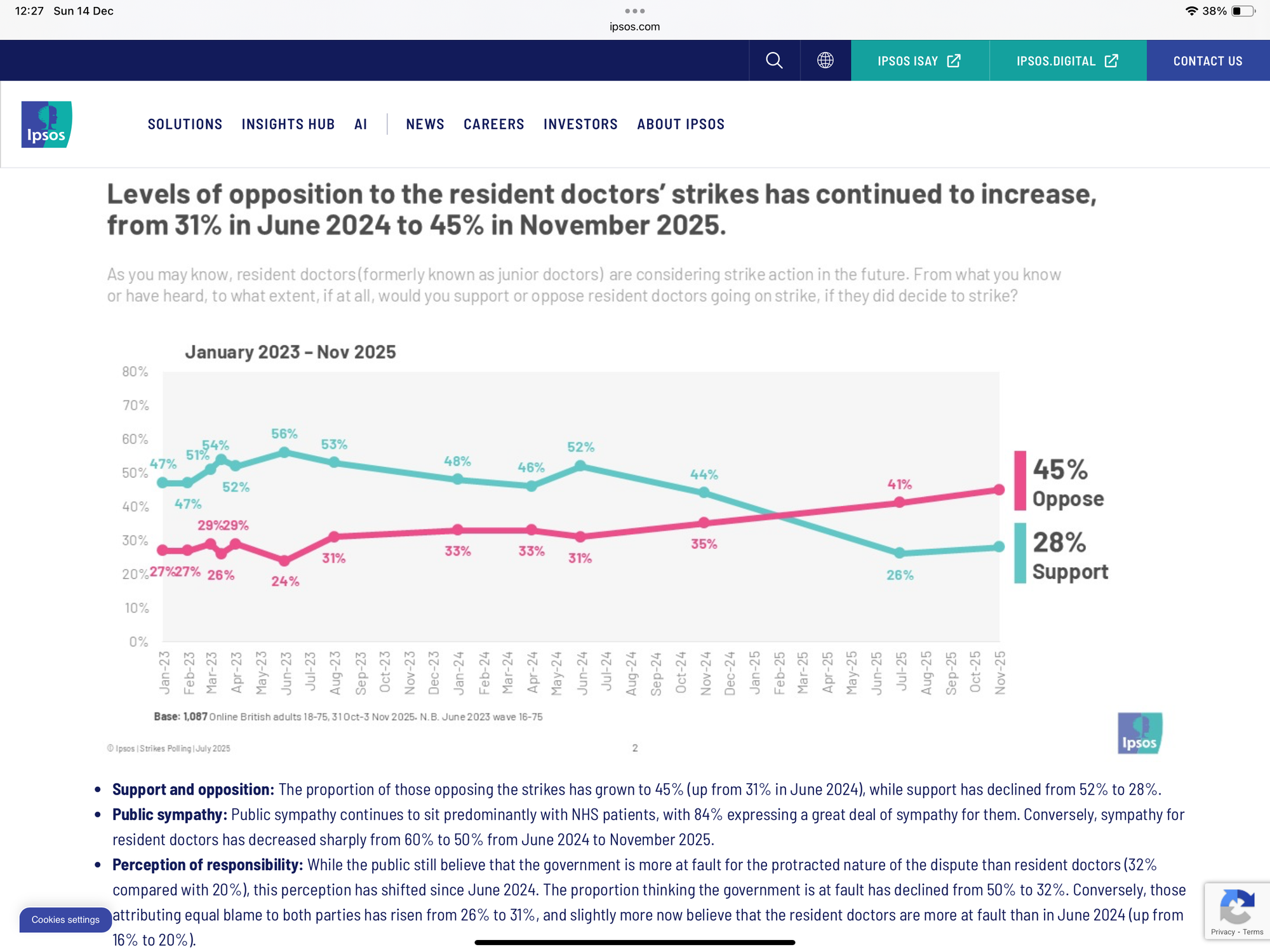
Ipsos polling from a month ago revealed a significant loss in public support for the resident doctors strike action.
Both sides are at grave fault for this ongoing dispute. It’s hard to want to side with either of them.
 Ella Bennett
Team Milburn-Streeting could and should have offered this package of changes months ago - and Young Master Wesley’s bathos-drenched shroud-waving that people may die and the NHS collapse because of the strikes co-inciting with the MegaFlu is particularly crass. We know from RCEM research that patients have been harmed or died in significant numbers over a decade-and-a-half of severe NHS winter crises.
The NHS doesn’t collapse: it just keeps on getting worse.
The BMA resident doctors leaders’ optimism that there will be further movement on money after having obtained a very decent chunk to settle the strikes last year was profoundly tone-deaf in a straitened economy.
Whatever their public pronouncements, if they aren’t looking for a face-saving climb down, they should be. Perhaps their members will provide it tomorrow.
Recommended and required reading
In an intriguing move, former Health Secretary, former Health Select Committee chair and former Conservative Stephen Dorrell’s company Dorson Transform bought Dr Foster from Telstra. Coincidentally (or not), Dr Foster co-founder Tim Kelsey has moved from AI firm Beamtree to recruitment consultancy Hunter Healthcare, where Roger Taylor is also joining. They’re getting the band back together!
HSJ spotted that millions of patients are being offered no choice of provider when referred for secondary care and tests: choice has not expanded in the past two years. Alan Milburn will be sad-face, despite the evidence showing that choice doesn’t really do much.
The Financial Times’ Steven Bush’s commentary on what can be learned from the British General Election 2024 book is instructive.
God bless the sheer unembarrassability of the Boris Johnson Fanzine: this piece on the agency staffing crackdown drawing solely from lobbyists Recruitment and Employment Confederation (REC) is a comic masterpiece.
The BJF have a piece on the Continuing Healthcare funding hokey-cokey.
The Federated Data Platform may be overspending its £330 million budget by over 200% (bad luck, the NHS App!), but just 16 trusts are currently using all the “core” parts of the £1 billion project’s suite of tricks.
Bizarre LinkedIn article by the UK Civil Service on DHBSC Perm Sec Sam Jones. Very hard to see what the point of this was meant to be.
In worrying news for the Tony Blair Institute, Oracle are having stock market problems.