Cowper’s Cut 422: Let their members vote on a deal? The BMA Resident Doctors Committee would prefer not to

The BMA Resident Doctors 2008 Pay Differential Historical Re-Enactment Society, perhaps more widely known as the British Medical Association’s Resident Doctors Committee (and henceforth as ResCom), now have a remarkable solid achievement to their names.
This solid achievement is not, of course, their dearly-held chimera of ‘Full Pay Restoration, NOW!’
‘Full Pay Restoration’ is not going to be happening.
Young Master Wesley: possibly right about a thing
It is rather that the BMA resident doctors’ leadership have caused me to think that Health But Social Care Secretary Young Master Wesley Streeting may perhaps, on balance, be right about a thing.
That is quite an achievement. I do not need to explain to ‘Cut’ readers that this distresses me greatly.
Idiots or agitators?
It is hard to decide whether ResCom’s leadership are merely idiots, or active political agitators. Clearly, they could be both. Neither option precludes the other.
It might be marginally less bad if they are just idiots, who have yet to realise that their basic argument is that the BMA as a trades union let its members’ terms and conditions decline seriously since 2008 (which is literally an entire generation ago). This argument has its fans. But that’s a situation for which the blame sits firmly and squarely on both the BMA for its weak and useless leadership, and on its members for tolerating that leadership.
If I were them, I would be quite careful about advancing that argument. People might notice the BMA’s tendency to amble off into cul-de-sacs of irrelevance.
Resident doctors had a very large catch-up pay rise from the current Government shortly after it took office. In current economic circumstances, they seem unlikely to get significantly more.
To give ResCom their due, they achieved a high membership vote for further industrial action (albeit on a low and falling turnout). Alas, their negotiators having reached a draft agreement with the Government, ResCom refused to put it to the membership and instead vetoed the deal and called next week’s strike.
The BMA ResCon statements is here: Young Master Wesley’s letter of response to ResCom is below,
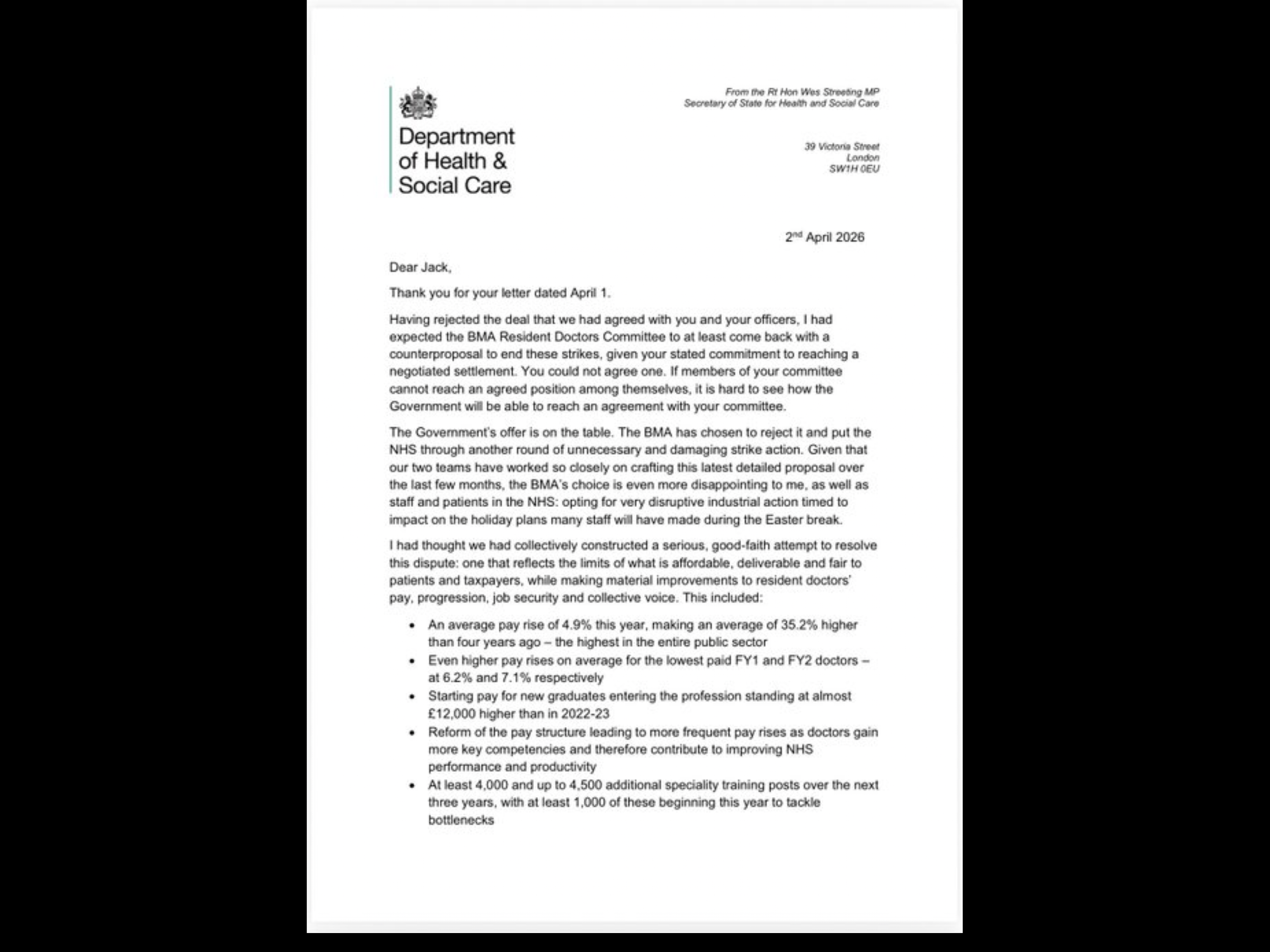
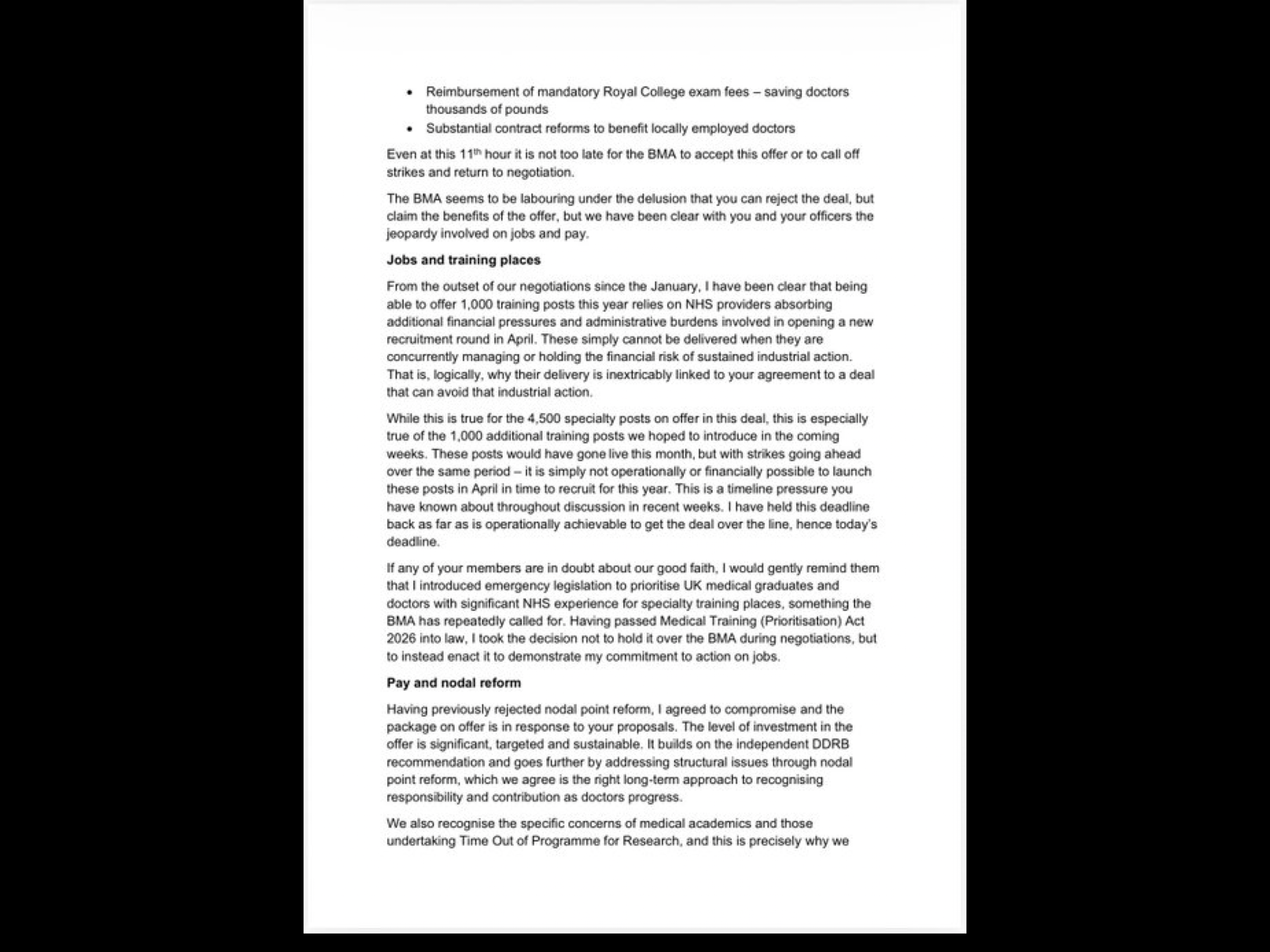
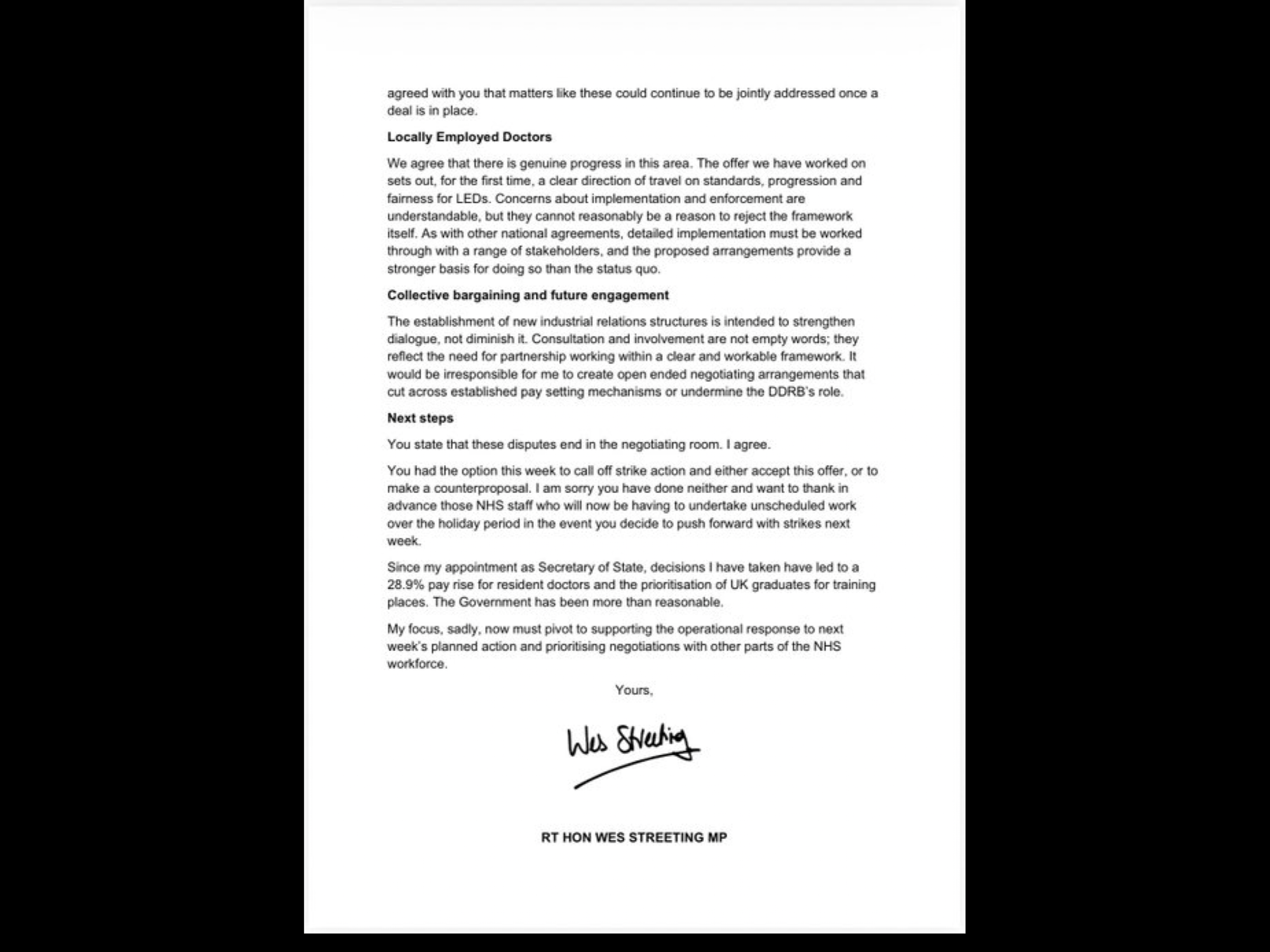
and his letter about the deal to resident doctors is here.
 Department of Health and Social Care
This put Young Master Wesley in a strong position regarding The Court of Public Opinion, and he lost no time in using this piece in the Boris Johnson Fanzine to emphasise his shouting points. The BJF is a fascinating choice for Young Master Wesley’s epistle to the apostles: it is by some way the least Labour-friendly national media brand short of Reform TV (sorry, GB News). Clearly, the Young Master feels that BJF support will be decisive in his future Labour leadership bid.
 Sir Keir Starmer
Young Master Wesley’s boss, PM Sir Keir Starmer got in on the rhetorical action with this piece for The Times, offering residents leaders 48 hours to reconsider their refusal to ballot their members on the deal offered.
The Prime Minister also warned that the negotiated 1,000 extra training posts this coming year (yes, the ones that there’s no meaningful infrastructure in place to deliver and teach) would not be happening if the strikes went ahead, due to the considerable extra NHS costs imposed by the strikes.
When it came down to trusting their members with a vote on the negotiated deal, ResCom’s leadership, like Bartleby The Scrivener, decided that they “would prefer not to”.
Nick Triggle
That’s those 1,000 extra training posts gone, then.
And speaking of The Court Of Public Opinion …
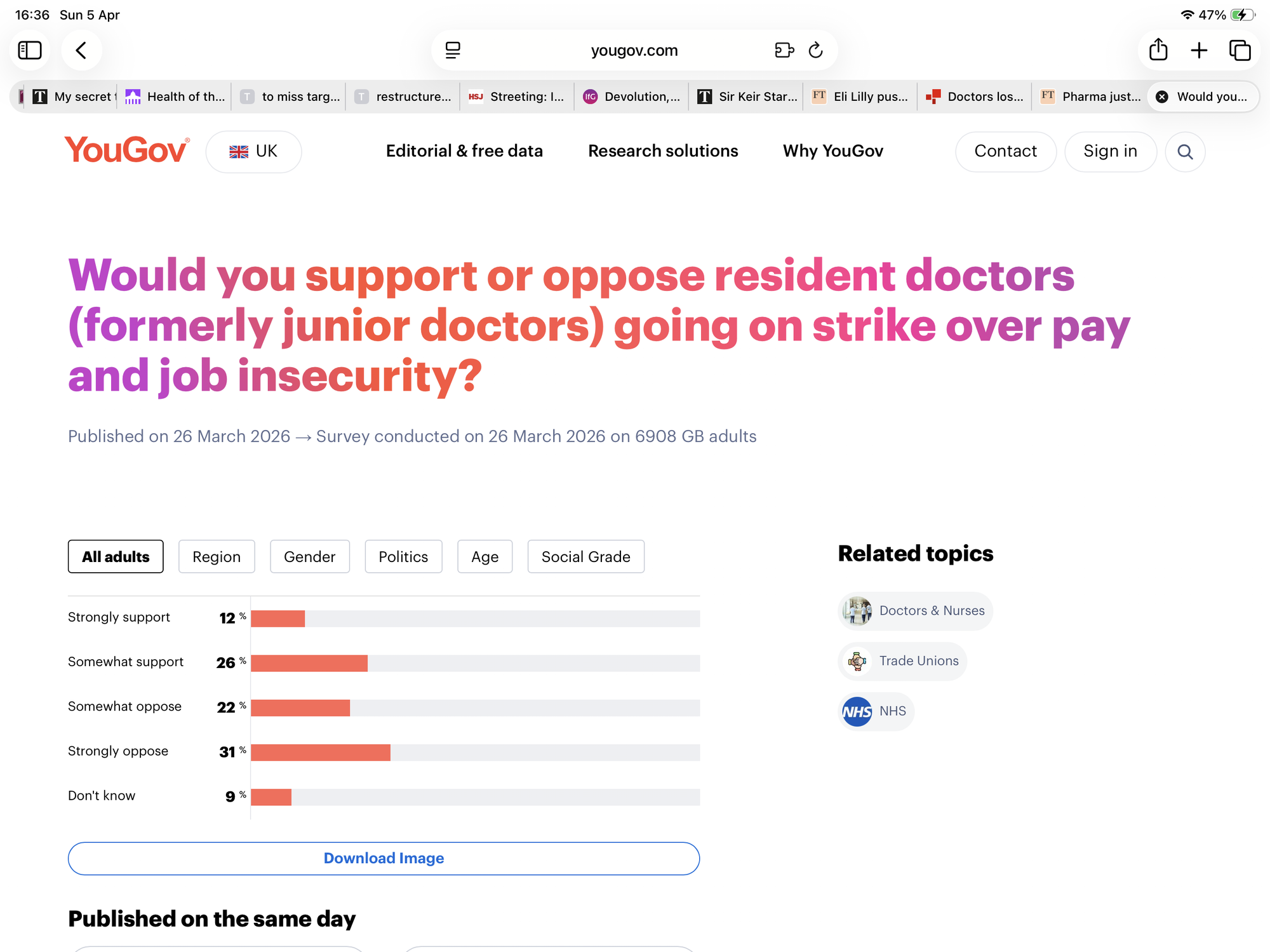
The latest YouGov polling on public attitudes to resident doctors’ strikes found that of those sampled, 38% support and 53% oppose strikes. It is worth remembering that in the previous strikes, way back when residents were juniors, public net support never went negative even after a very long campaign.
Dave West
Interim Jim Mackey, pro tem head of NHS England, made the required noises about digging in for a long strike and suchlike bellicosity. It is clear that there is unfaked anger among the NHSE senior leadership team about ResCom’s rejection of the deal.
He also told the NHSE Bored that the service would consider moving to new models of service provision relying much less on resident doctors. Interim Jim did not describe how the next generation of consultants would get fully trained under such a system, and claimed that the proposals were not meant as a threat. Of course not: perish the thought!
Interim Jim also told the Bored that remote and coastal small hospitals were longstandingly and serially among the NHS providers with the poorest care quality.
How the national system will in future openly acknowledge such a dirty little secret as this far sooner, and what the system is going to do about fixing this (apart from innovating in care models à la the huge success of the Five Year Foward View’s New Care Models), Interim Jim did not describe.
Sigh.
Dave West
Helpfully, Interim Jim also told Health Service Journal that the mid-redisorganisation Integrated Care Boards need to prove their worth as strategic commissioners.
This is fantastic news about the quality of analysis and thinking that exists at the top of the service, because commissioning in general (and strategic commissioning in particular) has always previously proven to be a brilliant and durable success.
Oh yeah, remind us what’s happening to Commissioning Support Units? Given that they are/were the bits of the NHS with any actual remaining commissioning experience.
Questioning the ‘Streeting the saviour’ narrative
Young Master Wesley does not appear to be on the wrong side of the issue over the residents’ latest strike. However, the negotiations to get to the offer on which ResCom decided their members could not vote have been protracted to a degree that suggests some level of delaying tactics.
The junior member of Team Milburn-Streeting is not covering himself in glory in other ways.
Alastair McLellan
Few things highlight his psychology quite as fully as his interview with Health Service Journal, in which he boasts about keeping the news of the abolition of NHS England a secret to HSJ: “I don’t see how we could have done it in a different and better way that would not have ultimately led to people reading about this major change second-hand … For once, we got one over on the HSJ”.
That was the win for Young Master Wesley. Media fixation much?
Politicians complaining about the media sometimes have good reason, and sometimes do not. Mr Streeting appears to be arguing that there is some merit in the hugely uncertain way in which the abolition of NHSE has been handled because it was kept a secret from HSJ.
This is a chicken-and-egg issue. People leak stories to and brief HSJ for as many reasons as there are people. Favour-banking, revenge, spite … take your pick.
But the real reason behind the abolition of NHSE remains a Sphinx without a secret. It isn’t the case that there wasn’t a case to hugely reduce the size of NHSE: it had become a weak organisation, which was weakly led, and one which oversaw a system with poor safety and quality control and no improvement strategy. The 2022 Act neutered its independence.
So some of its abolition was a recognition of political reality.
That said, nothing is either better or clearer in terms of how the new system will address poor safety and quality control or have an improvement strategy. Just look at the example of the national trust recovery programme being ‘re-set’ after three weeks.
Mr Andy Cowper
The Ten-Year Plan is not a plan.
I wrote extensively in last week’s ‘Cut’ about Young Master Wesley’s self-promotional speech in East London, including this section: “he also told a grateful public that the Care Quality Commission is being turned around. Nobody whatsoever in the English NHS believes this to be true.”
Emily Townsend
Imagine my surprise to find HSJ’s reporting that the consultation on the regulator’s plans to change its controversial single assessment framework found that suspicion of the CQC is “pervasive and deeply felt”, and there is widespread criticism of its inspectors. Providers and stakeholders warned the CQC’s new leadership (whoever they may be) to “expect scepticism to persist” until the regulator demonstrably improves its performance. Don’t hold your breath.
Denis Campbell
The Guardian this week noticed that English NHS performance is not in fact tremendously impressive. Their analysis finds that the English NHS looks likely to miss key targets to shorten waiting times for help at A&E, cancer care and planned hospital treatment.
The article also cites research by Magentus, a firm that works with NHS diagnostics service, showing that “the number of people in England waiting for a diagnostic test has hit 1.8 million, and that delays in getting an X-ray or scan are limiting the NHS’s ability to crack its still-huge backlog of care.
“The research also found:
- The number of people forced to wait more than 13 weeks for a test – well over the six-week supposed maximum – has risen to 139,652, the highest number since January 2024.
- Based on its recent growth, the diagnostic waiting list will hit 2 million by September next year.
- While NHS trusts are delivering large volumes of diagnostic tests, the waiting list for them is still growing.”
Oooops.
Recommended and required reading
The Financial Times reports on NHS staff refusing to work on Federated Data Platform projects because of Palantir’s negative reputation. This Times piece offers Palantir’s UK boss Louis Moseley a right to reply.
UCL Global Business School For Health launches ‘Health of the Health System Index – Annual Report 2025–26’.
Thorough Institute For Government piece looks at ‘Devolution, integration, prevention: Do the government’s public service reform plans add up?’
Another good HSJ comment piece by Andi Orlowski: this one is on how saving money is possible in certain circumstances.
France’s Ordre des Medecins, which is funded by doctors’ registration fees, seems to know how to make its officers’ lives lovely: also, not to discipline its members in cases of criminality. The French government has ordered a criminal inquiry, The Times reports.
The public inquiry into the Nottinghamshire mental health killings appears to be uncovering some scandalously bad practice, as the mother of one of the victims outlines in The Times.
The Trump-placating deal on drug pricing has been done, The Guardian reports.
Britain must agree to regular increases in NHS drug prices and phase out a multibillion-pound rebate scheme if Eli Lilly is to resume investment in the UK, the US pharmaceutical group has told the FT.
Novo Nordisk’s boss tells the FT that pharma companies are just “scratching the surface” of the huge potential market for weight-loss drugs, and should focus more on widening access.