Cowper’s Cut 402: Can’t they both lose?

On the one hand, we have the BMA resident doctors committee pursuing the chimera of the Dolphin “principle” of The 2008 Full Pay Restoration Historical Re-Enactment Society; on the other hand we have Secretary Of State For Health But Social Care and petulant Alan Milburn tribute act Wes Streeting.
Looking at these two opposing camps, one’s overwhelming thought is ‘can’t they both lose?’
Which, of course, they can.
And as I noted last week, probably the smartest move that Team Milburn-Streeting made since coming into office (if not into power) was to heavily publicise the significant pay rise that they immediately gave to end that industrial action.
That was genuinely smart politics: even people who don’t follow the news much heard that junior doctors had a socking great pay rise. Public envy and resentment at another huge BMA pay ask, so soon after that, is likely to be why all subsequent opinion polls about junior doctors striking for higher pay found that a majority of the public now oppose this.
As I also noted in last week’s column, public support continued throughout the (then)-junior doctors’ salary strikes against the last Conservative Government in 2023-24. The strikes became less popular as they went on and on, but they never dropped below a majority of public support.
Since the start of their current round of ‘Full Pay Restoration’ action, resident doctors’ strikes no longer enjoy public support.
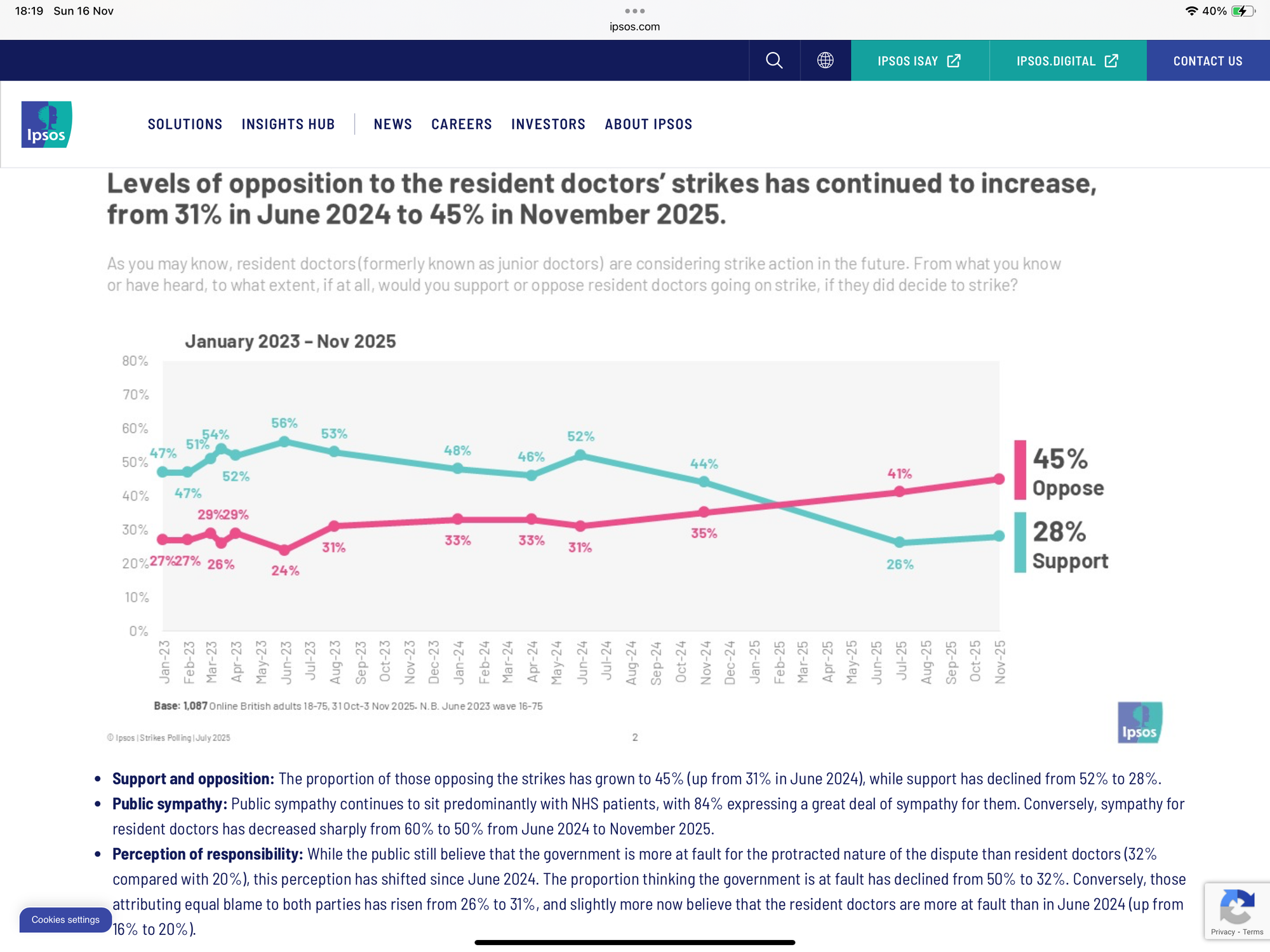
Ipsos polling confirms this change.
Not even resident doctors support resident doctors’ strikes
 Eleanor Hayward, Health Editor
The public don’t decide whether to cave in to the pay demands, but it’s a foolish person who thinks that public opinion is not highly important in industrial disputes.
The BMA resident doctors have a far better case on the subject of the DHBSC’s failure to deliver any meaningful progress on the many career development and training issues, but this is in the main not what is coming across from their arguments on the airwaves and online.
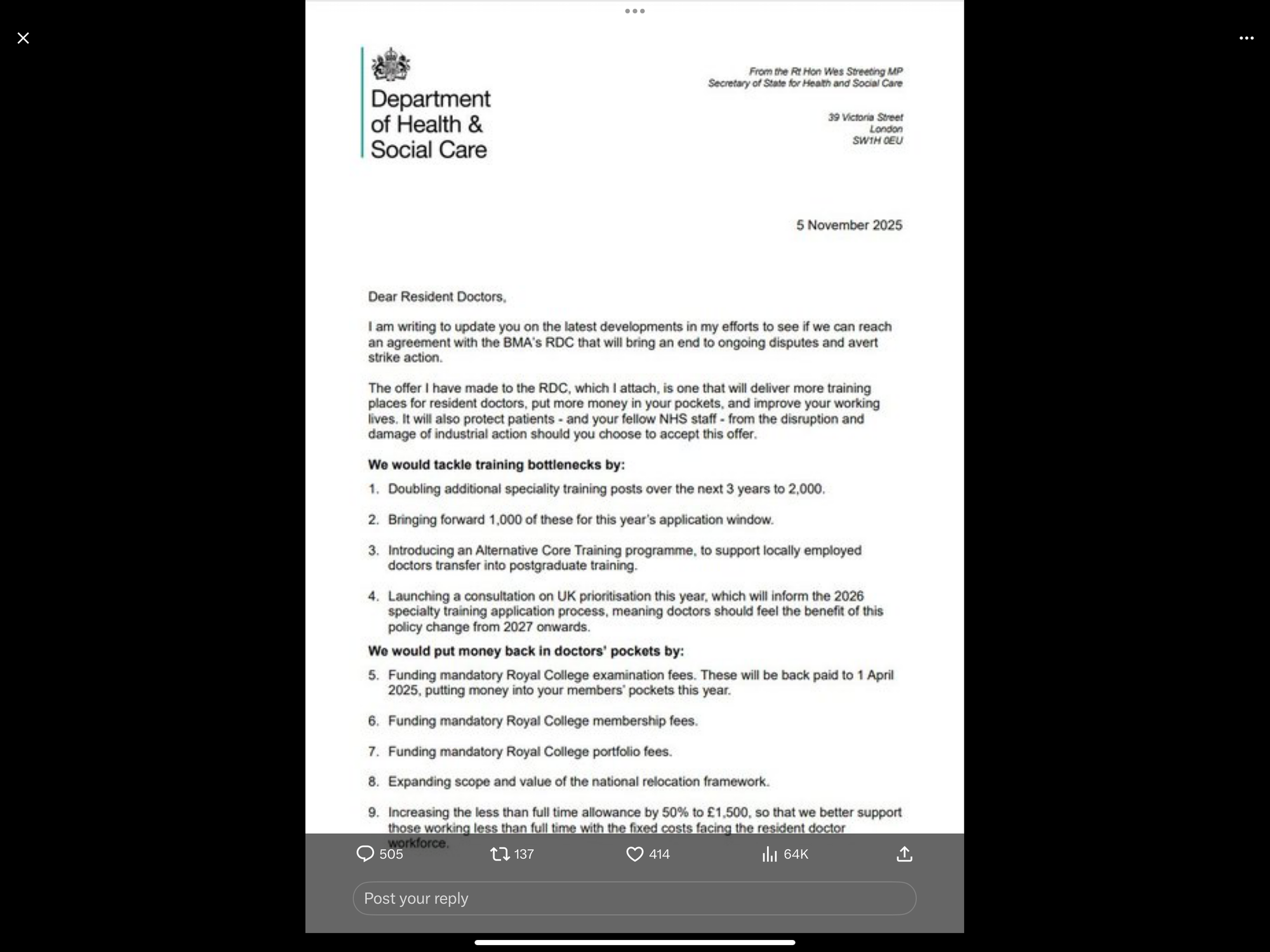
Their leadership failed tactically by not refocusing their campaign on these (real) problems, and by doing so, highlighting in concrete terms the paucity of Team Milburn-Streeting’s petulant ‘take-it-now-or-leave-it’ approach.
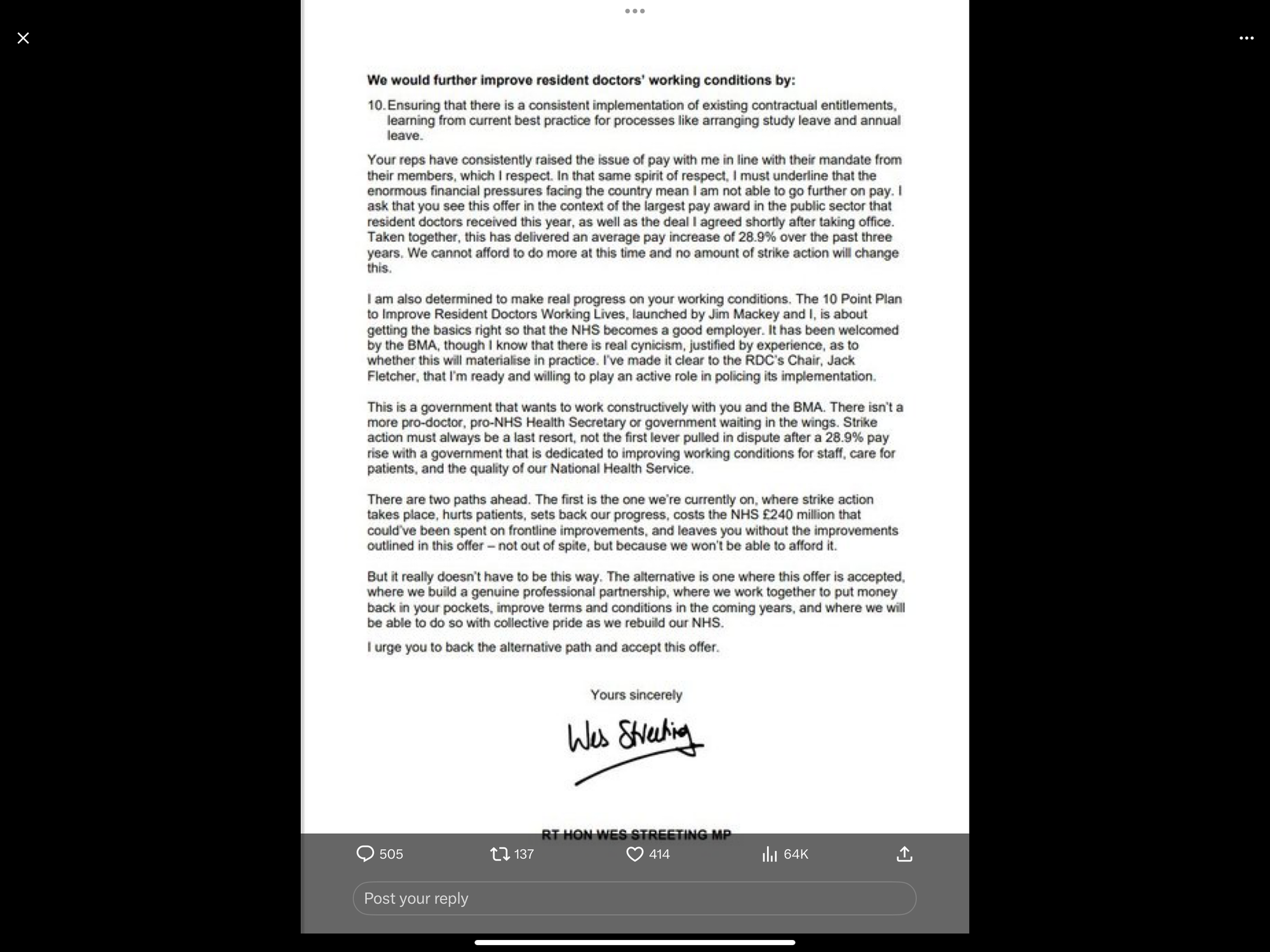
Team Milburn-Streeting are not very tactically astute, and could easily have been manoeuvred into uncomfortable positions by the residents’ leaders if that leadership had refocused smartly onto the issues of career progression, rotations and training.
But they didn’t, and so the BMA have agreed trying to extend their strike mandate in January 2026. Even with this ‘Doctor’s Vote’-pleasing prospect, BMA internal discontent (both staff-side and member-side) about how it’s all going resulted in these briefings to the friendly ear of The Guardian’s Denis Campbell. Denis even notes that the Doctors Vote entrust grouping imploded earlier this year, amid what one insider called “horrendous infighting”.
A far-left-wing group, imploding amid horrendous infighting?
Ahem.
One must have a heart of stone not to laugh.
And then, alas, we come to Young Master Wesley Streeting Esq.
Let’s start with how Mr Streeting can also lose in this dispute.
WATCH: @WesStreeting explains today's big announcement in 30 seconds ⏱️
— Department of Health and Social Care (@DHSCgovuk) November 12, 2025
For more: https://t.co/3LbJsuexW0 pic.twitter.com/bxEv5E892Q
For some reason, the Departmnet For Health But Social Care media team have decided that the ‘quick YouTube/X explainer’ video (a format favoured by no less a figure than the lamented Victoria Atkins) is a fantastic way to explain health policy in the Milburn-Streeting era.
Mmmmmmmmm.
The footage is taken backstage after Young Master Wes’ speech to the NHS Providers conference, which is held in the smallest possible area of Manchester Convention Centre. Tellingly, the cutaway reaction shot in this clip shows an audience of about 250 people for the Secretary Of State’s plenary speech. National NHS conferences have well and truly had their day.
The content is a re-announcement of the abolition of NHS England and reduction in ICSs.
This is remarkably mauve of Team Milburn-Streeting, as this was actually done (or at least announced) by PM Sir Keir Starmer back in mid-March.
The Great Redundo Fiasco
Except as ‘Cut’ readers know, it was done without any actual budget to fund the redundancies involved.
Ooops. Seems kind of important, as issues go. And kind of predictable.
So we got The Great Redundo Fiasco … until a compromise was finally found this week, reported by Health Service Journal’s Mimi Launder, whereby the Treasury will permit the NHS to overspend its set R-DEL budget for 2025-6 by this sum, and the NHS will ‘repay’ it via lower budgets in the following two financial years. Perhaps.
For now, the arcane details of this policy sausagemaking are unlikely to trouble a wider audience. The problem may start to arise around English NHS budgets in Q3 and Q4.
 Zoe Tidman
As I have been observing, the main narrative of The Mackey Interregnum (of which he reminded the unwary in his NHS Providers speech this week) has been Thou Shalt Break Even Financially At All Costs. I am increasingly hearing accounts and anecdotes to the effect that the successful reduction of English NHS deficit spending in the first half of 25-26 may not be sustainable in the second half.
Inevitably, a significant cadre of the NHS management community - even those not directly affected - have closely scrutinised this eight-month-long NHSE/ICS redundancy fiasco: people have not been greatly impressed by what they’ve seen.
The temptation for these people to hide, defer or delay a few significant financial things until - whoops! - they pop up in late Q3 or early Q4 will be considerable.
And in the words of The Divine Oscar, “the only way to get rid of a temptation is to yield to it”.
It is not clear that Team Milburn-Streeting are alive to this risk, but they should be. Somebody should have a little organisational memory about how backlogged Continuing Healthcare claims were stacked up to the ceilings in the offices of being-abolished-PCTs.
The war of words and the dog’s arsehole
Team Milburn-Streeting seem more preoccupied in trying to win a war of words with the BMA, as in Mr Streeting’s speech to the NHS Providers conference.
However opulently tempting this option may be, a wise Health Secretary (or health secretarial main advisor) would do well to remember that a SOS shouting at doctors is like a dog licking its own arsehole: just because one can do it, it doesn’t mean that one should.
Mr Streeting’s speech started with a fiesta of hostages to fortune, in the shape of promises: “we can still cut waiting times to 18 weeks, by the end of this Parliament. Something few thought possible when we made the commitment in opposition.
“And we can do it while delivering year-on-year improvements to Urgent and Emergency Care, we can get back to seeing people within four hours and while rebuilding general practice, so that patients can get an appointment with their doctor when they need one”.
Well, perhaps - although the Health Foundation doesn’t think so on 18 weeks RTT, and as the FT ‘in charts’ piece I’ve highlighted in the R&RR section below shows, long and very waits in A&E are not really improving.
On the Great Redundo Fiasco, Young Master Wesley told the conference, “I’m very alive to the uncertainty that’s hung over staff for far too long. And I don’t mind saying, it’s made me uncomfortable, as it should. Because I know we’re not just talking about jobs, we’re talking about people’s livelihoods. And again that is my responsibility. Not yours. I want to be honest with you and through you to your staff that I have not resolved this quickly enough”.
No shit. Still, ambition means never having to say that you’re responsible.
Some lines to bookmark for your ‘receipts’ file then follow, with Young Master Wesley’s pledge that “we are ending the constant assurance, ad hoc demands and micromanagement that you’ve been subjected to. The centre will instead enable you to focus on improving services for patients. A new department that empowers rather than suffocates NHS leaders and frontline staff.”
Against the doctors against the NHS
Mr Streeting told the event that it has “become increasingly clear that the BMA is no longer a professional voice for doctors. They are increasingly behaving in cartel-like behaviour, and they threaten not just the recovery of the NHS under this government, they threaten the future of the NHS, full stop. And I think that is a morally reprehensible position to be in.
“You look at the state of the public finances and the sorts of choices we’re making, especially for the NHS. Let me tell you, when we ask some of the wealthier to pay more, some of the most effective lobbyists against paying higher tax are the BMA consultants’ committee and the BMA pensions committee. So what they effectively do is say: ‘We want other people to pay the higher salaries for doctors.’
“And as much as, as a cancer survivor, I think my surgeon’s worth his weight in gold, we have to be honest and realistic about the challenges in the system, the challenges of public finances and the challenges facing every family, and it’s time for the BMA to get real.”
Mmmmmmmm.
In the first place, “get real” is a 1990sism that was officially banned by the Geneva Convention On Tired Public Rhetoric in their recent deliberations. Its use in any argument must now be seen as definitive proof of the weakness of the case being advanced.
Secondly, the BMA is many things, but a cartel is not one of them. It is not a closed shop. It does not represent all doctors. Its strikes are broken by its own members who disagree with the IA without meaningful consequence to those women and men. The BMA is before anything else a trades union: in certain areas, it has been effective and in the future it may be so again.
Mr Streeting simply has not made an effective case here to show that doctors “threaten the future of the NHS”. He has asserted it, but not come anywhere close to proving it.
He is particularly ill-advised in conflating the strikes with the issue of pensions: an area where BMA lobbying is indeed formidably effective and extremely well-informed. Pension taxation for those on high salaries is an utter mess, with monotonously frequent rule changes. There have been many cases where the rules and changes have seen doctors pay huge and unpredictable tax bills for doing overtime.
If Mr Streeting wants to motor through the NHS backlog, as his promises require, and can wring extra cash out of the Treasury to fund it then highlighting this area is singularly unwise of him. There is no alternative cadre of medical staff available. Shouting at their trades union, however deeply irritating it is, may not improve the vibe.
If English NHS deficit reduction is to emulate what was achieved in the 2000s, then the vast bulk of the work will again be done by NHS staff working overtime in NHS facilities. He could ask his fellow Labour MP for Shipley Anna Dixon about this - she was a co-author with Nick Mays and Lorelei Jones of the definitive analysis.
“Double-secret probation” freedom for neo-FTs
As classicists to a woman and man, I feel sure that many ‘Cut’ readers will be fellow fans of the film ‘National Lampoon’s Animal House’, in which the US university’s Principal Skinner (needing to take new disciplinary action against the notorious ‘Animal House’ fraternity) puts them onto “Double-Secret Probation!”
 Department of Health and Social Care
I thought about this when reading the announcements and Mr Streeting’s speech about new ‘Advanced Foundation Trusts’. It is no disrespect to the first trusts nominated for AFT assessment, who are
- Berkshire Healthcare NHS Foundation Trust
- Dorset Healthcare University NHS Foundation Trust
- Central London Community Healthcare NHS Trust
- Northamptonshire Healthcare NHS Foundation Trust
- Northumbria Healthcare NHS Foundation Trust
- Alder Hey Children’s NHS Foundation Trust
- Norfolk Community Health and Care NHS Trust
- Cambridgeshire Community Services NHS Trust
to say that this is an intriguingly disparate bunch. Of these eight, three are not even foundation trusts.
This list gives a strong sense of a group of trusts selected by a finance-dominated algorithm (hopefully, using special Tony Blair Institute AI). It is notable that the press release claims that “thousands of NHS patients are set to benefit” from this initiative, which may inadvertently be almost exactly right.
(The RTT backlog is over 6 million people. Just saying.)
But what is particularly adorable is this follow-up HSJ news story, which reports that “the new advanced foundation trusts will be allowed to save up and then reinvest their revenue surpluses into capital projects, according to guidance out for consultation”.
I laughed until I stopped.
So double-secret probation neo-FTs are going to be able to earn the kind of revenue from cash-strapped strategic commissioning ICSs (ahem) that will enable them to invest in meaningful capital projects?
This is nonsense on steroids.
Recommended and required reading
Financial Times ‘in charts’ piece asks if the NHS is on the road to recovery.
The FT also reports on NICE’s chief executive’s comments at an FT pharma event that the NHS medicines budget should not rise with inflation.
A blinding week for the FT, who followed un on generic niche pharma price pirates Cinven.
BBC News research finds that the 62-day cancer target is being missed almost everywhere.
The English RTT waiting list actually shrank by only 16,000 pathways in the latest figures for September, and in his latest HSJ piece, the estimable Dr Rob Findlay explains why this is consistent with year-round growth in the waiting list, rather than the professed recovery.
Latest ‘State Of The Provider Sector’ for 2025 from NHS Providers.
Intelligent Chris Giles piece in the Financial Times on the UK economy: short and true.