Cowper’s Cut 401: ‘Resident doctors revolting? Try this one weird trick: petulance!’

Petulance is never a great quality in a person: nor is it in Secretary Of State For Health But Social Care Wes Streeting.
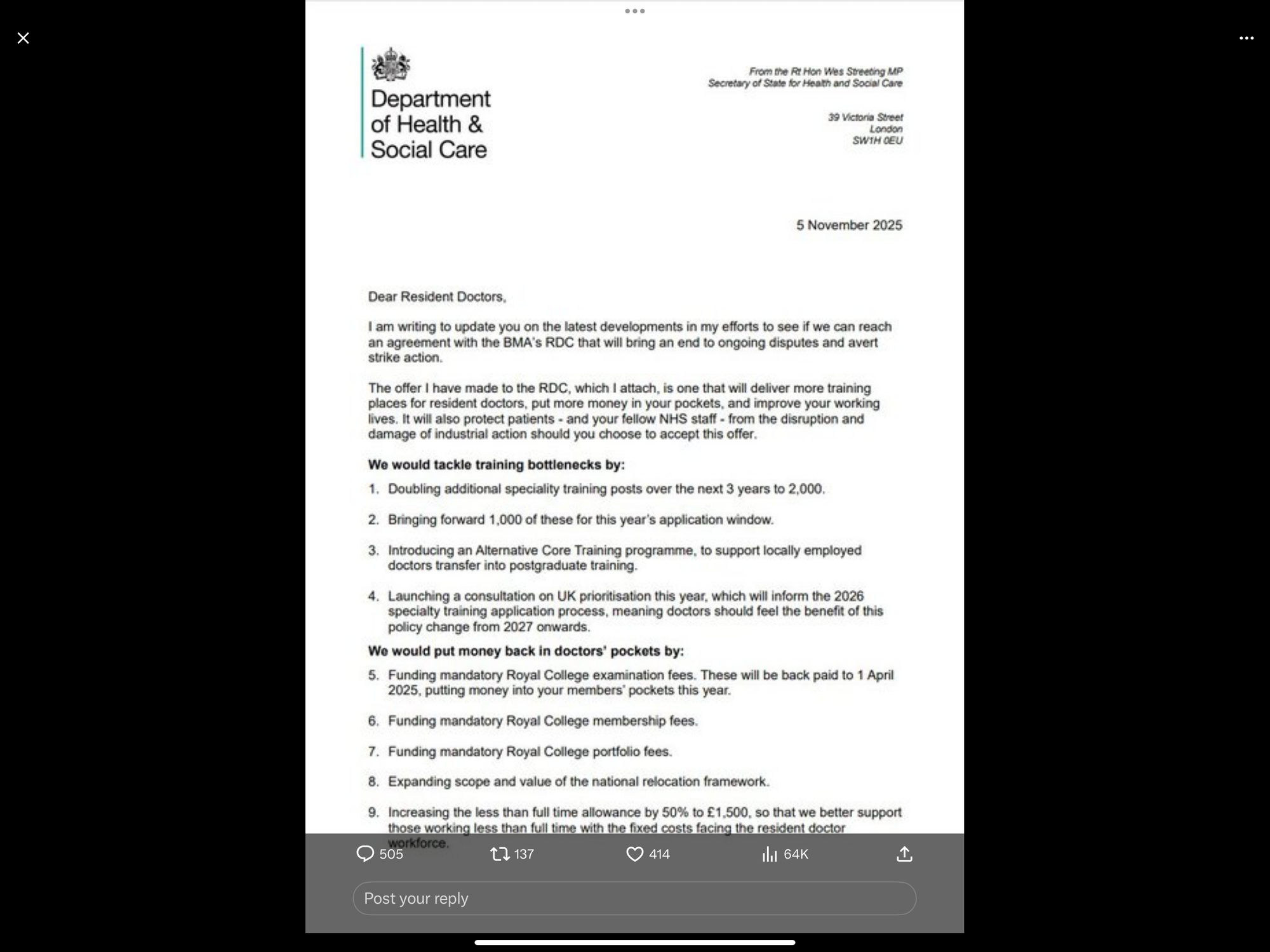
Mr Streeting’s letter to BMA resident doctors is a remarkable thing to read, but not in a good way.
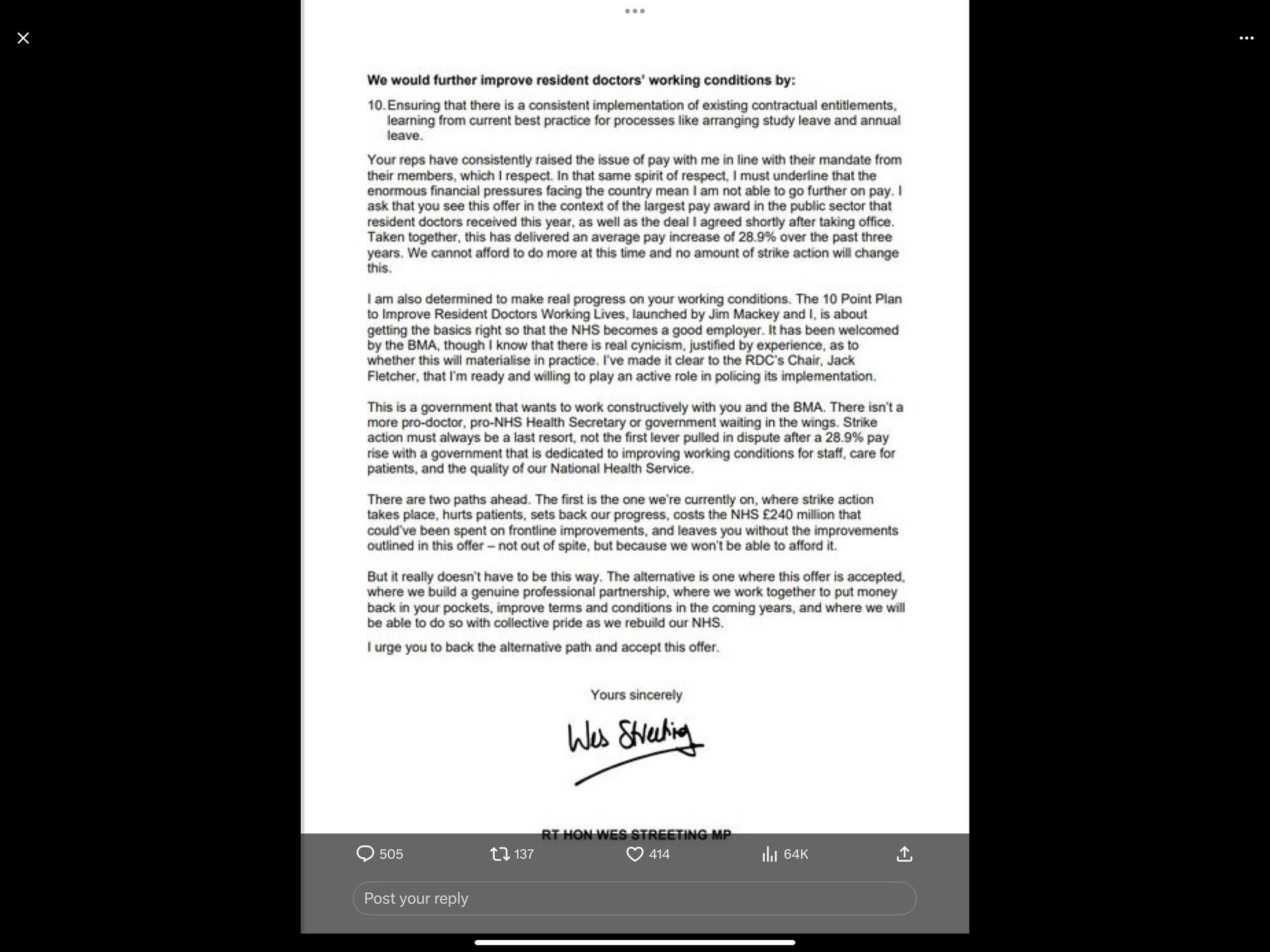
The tone of Young Master Wesley’s letter, and the relatively paltry nature of his offer to residents to call off the strike, on a take-it-today-or-lose-it basis, suggests either a profound incomprehension of the ‘no jobs’ situation facing so many resident doctors or an heroic indifference to a key part of the acute clinical workforce.
It is profoundly petulant - particularly the short deadline. This is not the conduct of a confident neogotiator.
I have touched on the issue of the BMA’s Historical Re-Enactment Society For The Restoration Of The 2008 Pay Differential frequently in these columns. Suffice it to say that the one smart move that Team Milburn-Streeting made towards the resident doctors was to ensure that maximum publicity accompanied their pay rise given last summer to settle the industrial dispute, following Labour’s general election victory.
The consequence of this was that many people, even people who don’t greatly follow the news, heard about the resident doctors getting a significant pay rise. This will be impacting on the opinion polls now showing that the majority public support that was found throughout the strikes from 2023-24 has now gone (latest YouGov poll: 51% oppose; 40% support).
There is a significant problem with the lack of training places for doctors. This isn’t imagined. It also isn’t surprising: once the system expanded training places for doctors as well as increasing international medical immigration without expanding the necessary posts for them to go into (and, crucially, expanded the role of training in consultants’ job plans), then you’ve got a recipe for serious problems and dissatisfaction.
The utter failure of the campaign to introduce the physician/anaesthetist associate roles without broad medical consent should have warned those in charge of workforce planning that medics do actually notice what is happening, and can do significant amounts about it.
Meanwhile, Health Minister Stephen Kinnock told the Boris Johnson Fanzine that the BMA’s decision to oppose online booking in primary care means that “the current leadership of the BMA, whether on the GP committee or resident doctors committee, seem determined to turn their organisation into a farce.
“We’ve always been clear that we want to work constructively with the BMA – but they stand resolutely in the way of changes vital for patient care, and for the progress their members want to see too. This latest escalation is founded on untruths and will put patient safety at risk at a critical time ahead of winter.”
The productive Commissioning Board
 Jack Serle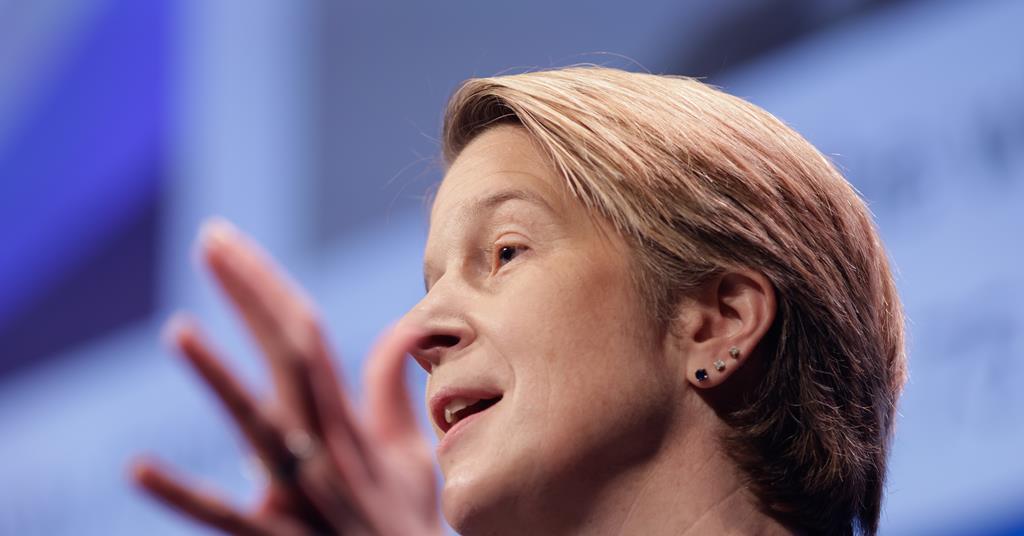
You will remember the magnificent denial from Amanda Pritchard, The Woman In Black, that the English NHS had a productivity problem. Bless.
There is a fairly broad consensus that productivity in the English NHS has fallen dramatically since the pandemic. The new report from the Health Foundation’s NHS Productivity Commission provides further evidence, and the Financial Times adds to the conversation with this report on the latest ONS data indicating that productivity measured across the whole system is falling, despite increases in acute productivity.
The Health Foundation report finds that the English NHS has “lost a decade of productivity growth … (with hospitals) holding on to old ways of working.
“Had pre-pandemic trends continued, the NHS in England would have been 14 per cent more productive in 2022-23 — equivalent to around £20 billion of the NHS budget. That is enough for millions more outpatient appointments or tens of thousands of extra major operations.”
The HF’s Anita Charlsworth rightly told the media that Team Milburn-Streeting’s planned NHS reforms “are on a go-slow … an enormously destabilising restructuring, which they haven’t got the redundancy funding for. The leadership and management to actually see through the transformative change is, at the moment, consumed with restructuring.”
 HM Treasury
The emphasis on Team Milburn-Streeting’s lack of meaningful and effective NHS reform plans is timely, given that Chancellor Rachel Reeves this week gave her (first of several?) ‘pitch-rolling’ speech ahead of her Budget on 26 November, which seems certain to break Labour’s manifesto pledge and raise some of the three major taxes.
The new leadership of NHS England/Department For Health But Social Care has, as noted several times in these columns, put its primary emphasis on the necessary-but-not-sufficient precondition of getting the English NHS back into financial equilibrium.
 Nick Kituno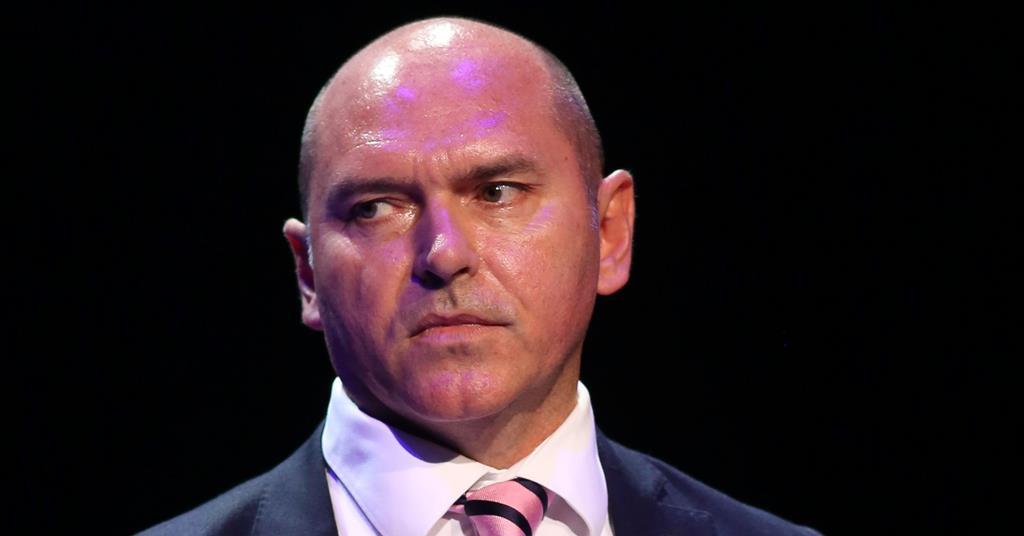
Interim NHS England chief executive Sir James Mackey’s speech to the Kings Fund’s annual conference this week majored on the English NHS funding changes currently being developed, as Nick Kituno of Health Service Journal reported.
Sir James told delegates, “as an ex-finance person, when you look at all of the things that we’re trying to change at once, I’ve never seen anything that big before. It’s all absolutely terrifying, when you put it all together and you see it as a package, of all the things that we’re trying to change.
“One of the biggest [changes] is the unbundling of the block. The evil block contracts. That’s made us lose sight of what we’re providing, commissioning, the data quality, the specificity and standards.”
Sir James suggested that the “unbundling” process of block contracts – analysing the value of each contract and what activity it is paying for – would later “allow the flow of funds to make sure that, if somebody’s doing something in the community, and it does prevent that admission, the money will flow … the counterfactual of not changing them is much worse, in which we could not have continued as we are. We really need to do this, but it’s all about how we’ll manage this together”.
It’s not wildly reassuring: nor is Sir Jim’s expression of hope that the government will confirm a solution to fund the estimated £1 billion one-off redundancy costs in ICBs and NHSE before the Budget.
Sir Jim said, “I’m confident that we’re close to resolving it [and] I would hope that it gets resolved properly before the Budget. We are kind of there or thereabouts. We are much closer in terms of understanding it all … But the conversations have been pretty constructive. I think all sides know where we are. It’s not fully resolved yet, but I hope very soon it will be resolved”.
Um, maybe. But how much is there to understand here? To will the end of abolishing NHS England and halving the regional management infrastructure of ICSs and ICBs must be to will the means.
Mmmmmmmm.
The whole situation still feels exactly as if nobody is in any meaningful charge of what is going on.
Recommended and required reading
‘Ending The Patient Gridlock’ is a useful new report from Re:State thinktank (formerly Reform) on NHS hospitals and patient flow.
The Guardian’s David Conn has this intriguing dig into the role of Uniserve during the pandemic’s PPE supply scandal, including the firm being paid £1.4 billion for Covid contracts that included supply of £178.5 million in never-used equipment.
Very decent piece by Lauren Bevan on ‘The Cost And The Price Of The NHS’.
Concerning new BMA report on the prevalence of sexism and sexual violence being faced by many UK medical students.
The US Ambassador adds to the warnings about the need for urgent pharma price rises to prevent companies exiting the UK, as The Times reports. It’s worth considering this alongside Tom Whipple’s Times piece on pharma pricing and quality of life, which mentions our late friend Professor Alan Maynard.
The FT reports on scientists’ discovering possible genetic risk factors for cancers and psychiatric disorders in a pioneering project to map the human brain in the sharpest detail yet, and on the promise of AI-designed antibodies to deliver a big boost to drug development.
Comment piece in the Sunday Times from former Health Secretary Jeremy Hunt saying that the ‘normal birth’ ideology is killing babies. Driven, presumably, by this ST feature on the issue.